The COO playbook: scaling startups & FMCG growth
Arul Oli beat Cadbury in a Karnataka channel by paying cashiers four rupees a bar. Two decades later he sells dates at ₹2,000 a kilo. The through-line is the same — availability and visibility, done properly.
Watch the full episode on YouTube
Executive summary
Arul Oli has spent two decades in FMCG sales and sales leadership — Wipro Consumer Care, six years at Mars India across pet care and chocolate, Pro Nature Organic, Del Monte, and now Chief Operating Officer at Flyberry Gourmet. Big corporates and bootstrapped startups, both sides of the coin.
The episode is a working education in how physical products actually reach people in India. Three ideas carry it.
First, the two words he returns to more than any others: "In any FMCG company, the most important things are availability and visibility."
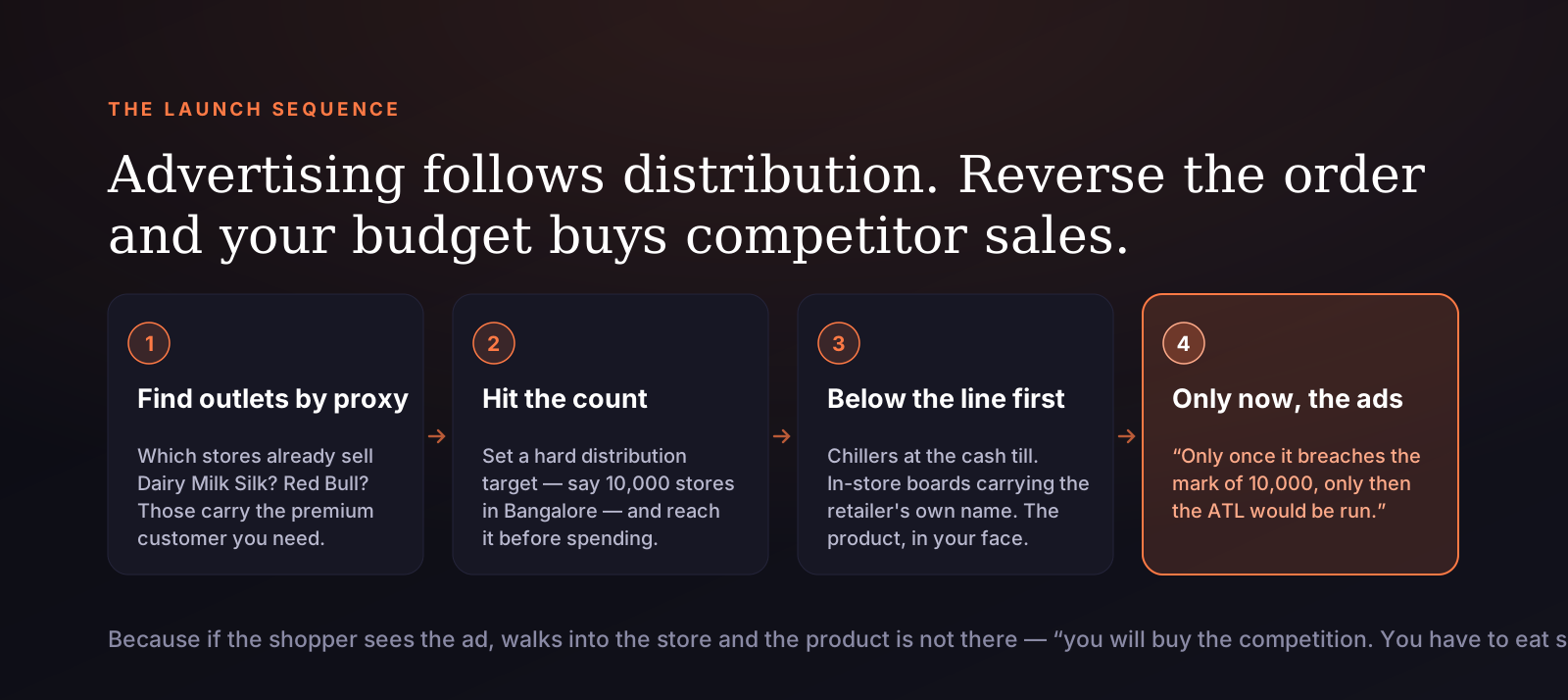
And the reason, stated with unusual bluntness: "Even if you put out ads like 'you're not you when you're hungry', or you ask XYZ Bollywood celebrities to dance and spend money — when you go to the store to buy the product, if it is not there, nothing will work out of it. You will buy the competition, because you have to eat something."
Second: the market is large enough that you never need the majority. His entire method for entering a new category compresses into one calculation:
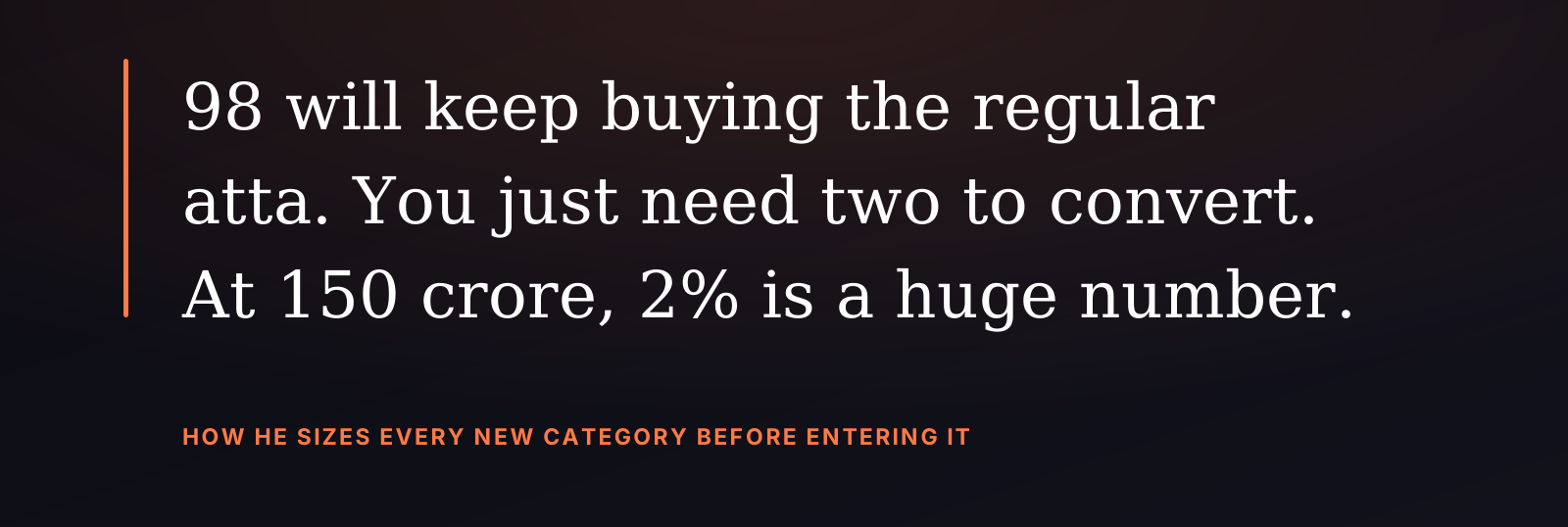
"If there are 100 people today, 98 of them will continue to buy the regular atta. All you need — India is such a big market — you just need two people to actually convert. At 150 crore, 2% is a huge number."
Third: the unglamorous execution is where the wins actually come from. Not the campaign — the chiller, the cash till, the shop board, the ₹4 incentive.
The story
He joined Wipro Consumer Care and Lighting as a management trainee on 2 May 2006. One week of presentations at the corporate office, then the field — Kerala, selling light bulbs, CFL lamps and electrical fittings.
"To go from an MBA institute to the field and sell light bulbs — my God, that was the real learning. Whatever we have learnt in the books is different, and what we learnt on the job is completely different."
Wipro's programme rotated trainees through three roles in twelve months: a salesman stint going shop to shop, an executive stint handling a team, then an area manager stint. Ground level to management in a year.
The delivery method was less gentle than the curriculum:
"Literally it's like dropping you in the middle of the ocean. They sent me to a remote part of Kerala, which is Thrissur. And in 2006, there was no internet. I stayed in a lodge. I didn't know anybody in that town, but we had to work the whole day."
Of nine trainees from different campuses, only four or five made it through the first year. "FMCG sales is not for everybody."
The mechanics of the job then are worth preserving. You shadowed a distributor's existing beats — a fixed list of outlets visited on a fixed day. No automation, no handheld tablet. You wrote the order on paper, filed it at the end of the day, posted it to head office, and your manager reviewed it there.
And here is the part that surprises people: it has not really changed. "Even till today, a lot of categories — 95% of the sales happen like this. Only 5% is the new age D2C and e-commerce." Santoor, which he helped sell and which is now India's number one soap, still moves the traditional way.
Which is why his answer on relationships is not nostalgia:
"Whether you are selling to a Kirana store or to Amazon, at the end of the day the customer is the same. The key account manager at Amazon is my customer, and the owner of that Kirana store is my customer."
As area manager in Hyderabad in 2007, he was put in charge of launching Wipro's new categories — Baby Soft, Sanjeevani honey, glycerin soap, sweeteners. That is where he found what he actually enjoyed: zero to one.
Then, in 2009, a batchmate mentioned a company trying to sell pet food in India. He knew nothing about pet care. He met the sales director, Bala Subramaniam — Mars's first associate in India, now CEO of 24 Mantra Organic — and was persuaded by the idea of building a category that did not yet exist.
Mars itself sealed it. He walked in expecting the cubicles and hierarchy he knew from Wipro:
"I was pleasantly surprised when everybody was sitting in the same hall. There was no cubicle. Even the GM for India, Mr John Webb, was sitting in the same hall. Even the conference room did not have any blinds."
The company does not call them employees. It calls them associates.
Key decisions
Decision 1 — Build the category, not just the brand
In 2009, selling dog food to Chennai retailers, the reaction was ridicule: "Sir, how can you expect dog food to be on the shelf?"
His counter was not a margin argument. It was an invitation:
"The manufacturing of our pet food in the factory in Hyderabad is equal, if not better than, your five-star hotel. Why don't you actually come and visit our plant?"
He was also selling a forecast, honestly labelled as one. Mars India was doing about ₹100 crore in pet care that year. They told distributors it could be ₹500 crore in five to ten years, on the back of millennials becoming pet owners and Gen Z growing up behind them.
The pet food category in India today is close to ₹10,000 crore.
The linguistic shift he points to captures the whole change: "earlier the lingo used was pet owner. Today it has moved to pet parent." Alongside DINK households — double income, no kids — that reframing pulled in grooming, supplements, boarding and fresh cooked food.
Decision 2 — Sell a chiller before you sell a chocolate
Mars entered Indian chocolate against a Cadbury that had owned the market for fifty years and an audience raised on Dairy Milk. Their five brands — Snickers, Galaxy, Mars, Bounty, Twix — were billion-dollar names globally and unknown here.
Rather than compete on advertising, they competed on the product's condition:
"We were the first ones to introduce this concept of chiller. Chocolate tastes best between 16 to 20 degrees. Anything over 25, the cocoa butter will start to melt, and it will not taste the best."
They installed one lakh chillers in Kirana stores across India, positioned at the cash till, and insisted their range sat inside. Cadbury and Nestlé followed.
The second move was price. Snickers came down from ₹40 to ₹15 to reach the entry level — "because in India, price point is even till today the key. That's what makes the customer enter the category."
Decision 3 — Pay the cashier
The story he tells with most obvious pride. Working with Mr Kapil, the chocolate category manager at Big Bazaar, they moved Snickers out of the chiller and onto the cash till in air-conditioned stores — then incentivised the person actually standing there.
"We gave 4 rupees as an incentive to the cashier for every 40-rupee bar. 2 rupees was funded by Mars, 2 rupees by Big Bazaar."
Within a year, AC Nielsen reported that in Karnataka modern trade, for the first time, a company had beaten Cadbury on market share. He was sent to visit Mars's chocolate factory in China as recognition.
Fifty years of incumbency, undone in one channel by a four-rupee alignment of incentives.
Decision 4 — Leave the safety net deliberately
Around 2016–17, ten years into his career, he noticed something about all of his successes:
"No doubt you have been working for newer categories, but at the back of your mind you know that there is a big daddy who is supporting you. Mars is a big company globally."
So he asked the uncomfortable question — "can I work in a company which does not have such deep pockets, or such a big brand name? And can I really make a difference there?" — and treated it as a challenge rather than a risk.
That took him to Pro Nature Organic in 2017 as sales head, after meeting founder Varun Gupta at a foundation event mentoring startup founders. The organic category grew 20–25% that year. Pro Nature grew 55% and above, and won an award for best organic company.
Mental models
Availability and visibility
The two fundamentals, and the discipline that survives every change in channel. Availability means the product is physically there when someone reaches for it. Visibility means they see it without looking.
He points out that quick commerce did not repeal this — it relocated it. "You have to browse through. You see a product, you want to take it. It's the same concept you have to do on Blinkit."
Two kinds of operator
"There are certain people who like to work in just big systems, like a Unilever or ITC or L'Oréal, because they want to work along with the system... The other way is there are people who want to create from that zero to one."
He is firmly the second, and clear-eyed about the cost: zero to one demands "passion, perseverance and patience", and even then "it is not a certainty that any brand or any category would take off." Driving an established hundred-crore business is a different job requiring different temperament.
The values filter
An unusually personal hiring criterion, applied in reverse — to employers:
"I have wanted to join organizations which have products whose values I subscribe to. I will not try to sell something which I do not subscribe to."
The test he actually uses: "until I am convinced that I will feed that to my kids, I will not work for any company just like that."
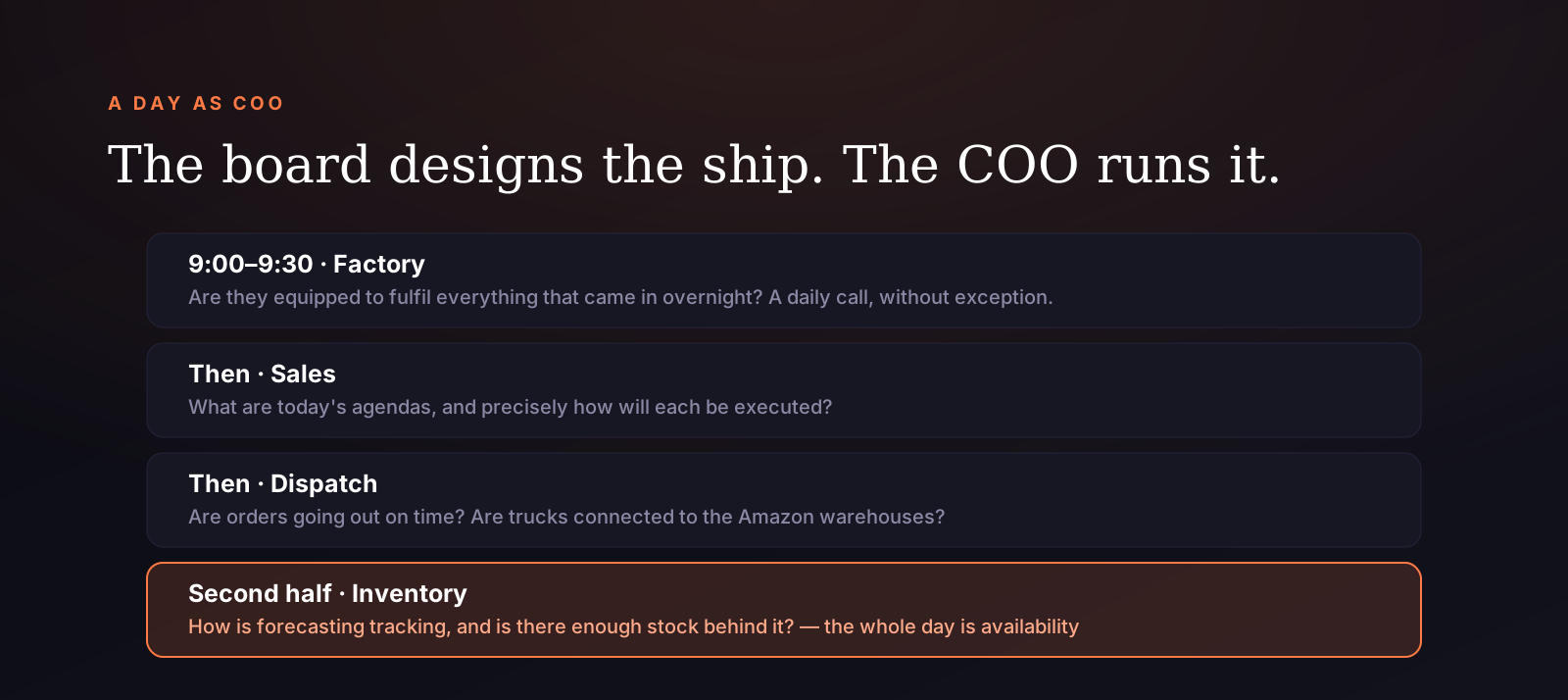
The COO runs the ship
His summary of the role, and the cleanest available distinction between strategy and operations:
"The board of directors and the CEO discuss more about the strategy. The COO's role is to execute the strategy... Somebody designs the thing, and the COO runs the ship."
He is also candid that a startup COO's day is "interchangeable and slightly more chaotic — and that's what you come in to do."
Frameworks
Framework 1 — The niche calculation
The method he applies before entering any category. Do not ask whether most people will switch — they will not. Ask what 2% of the addressable market is worth.
He used it at Pro Nature: 98 out of 100 will keep buying regular atta, and two converting is an enormous business. He used it again at Flyberry, where the product is dates priced at ₹2,000 a kilo against a market selling at ₹250–300.
"Amazon almost laughed us off — you're trying to sell dates at 2,000 rupees a kg, and who will buy it? But I was convinced that there is an opportunity there."
Then quick commerce said the same thing: how can a ₹2,000 product sell here? They convinced Swiggy Instamart anyway.
His argument for why category managers eventually say yes is a good one: "everybody is waiting for the next revolutionary product." Yoga Bar had no equivalent in India when it launched, and someone still had to back it. "It is our job at the end of the day to convince them" — and it becomes a win-win, because the platform wants both volume and higher value.
Framework 2 — Different pack, different channel
The most transferable commercial insight in the episode, and the reason Flyberry works on platforms that initially refused it.
On Amazon, the 1kg and 500g packs are the best sellers. On quick commerce, the 200g entry pack is.
"The quick commerce customer wants good products, but price point is very, very critical. So we purposely chose to launch the smaller pack."
Same brand, same quality, deliberately different unit — because the channel's shopper is in a different mindset. The business now does in excess of ₹50 lakh, in its third year.
Framework 3 — How a conventional FMCG launch actually runs
Using Galaxy as the worked example, and the sequencing is the interesting part.
Find your outlets by proxy. Rather than guessing which stores serve premium customers, they used other brands as indicators: stores stocking Dairy Milk Silk in chocolate, and Red Bull in beverages. Those outlets have the audience Galaxy needs.
Set a distribution count and hit it first. Target, say, 10,000 stores in Bangalore. "Only once it breaches the mark of 10,000, only then the ATL would be run."
That order matters enormously and is routinely inverted by newer brands: the advertising follows the distribution, not the other way round. Spending on awareness before the product is on shelves converts your budget into competitor sales.
Framework 4 — Buy visibility with something other than money
His proudest execution, and a masterclass in leverage.
Posters get replaced — "the next day the other company person will come, Cadbury or Nestlé, and they will put their poster and go." So instead they funded permanent in-store branding: shop boards carrying the retailer's own name alongside the product.
"We put Snickers, number 15, and then we put Maruti Kirana. Maruti Kirana felt happy because he got a board for 20,000. But Snickers got the visibility."
His team executed 1,000 in-store brandings in Bangalore, and paid for exactly two. The other 998 were free, because the retailer received something he genuinely valued.
Then the targeting, which cost nothing at all. They picked clusters — small bakeries and Kirana stores around Christ College (his own alma mater), Jyoti Nivas, Mount Carmel, Bishop Cotton — "because that is where this TG goes to pick up those products."
"And that did not have any advertisement which runs into crores."
Lessons
Snickers won on positioning, not indulgence. Every other chocolate sold itself as a dessert or a treat. "Snickers was the only one which actually focused on hunger" — you're not you when you're hungry. It satiates a sweet craving and genuinely fills you, which is why it ended up in airport bags and endurance athletes' kit.
COVID did two things, and both were accelerations rather than changes. It advanced the shift to healthier eating "by at least a decade" — palm oil became a red flag almost overnight. And it forced e-commerce onto people who had avoided it, himself included. "It would have caught on anyway in five, ten years."
Proximity was a supply chain advantage. Del Monte's ketchup is made in Hosur while a major competitor's comes from Baddi — during lockdown, that distance was decisive, and their teams were first to get field passes.
Where he thinks the growth is: premium healthy foods and protein in everything; kids' foods, cosmetics and oils; supplements; and two he singles out.
Pet supplements — currently served almost entirely by imports designed for other countries' breeds and climates, and more expensive for it. "India is known as the re-engineering hub... India could tomorrow become one of the global hubs for export of supplements."
Organic skincare oils — high margin, few niche players, and a strong export angle. "Anybody who puts the word Kerala and Ayurvedic actually gets a premium." His advice is to lead with what India is genuinely known for — virgin coconut, almond, neem — rather than chasing avocado oil.
And his closing message: "Go back to the basics. If you do the basics well, especially in FMCG, the basics is what actually will lay the foundation for scale." Followed by: "Keep your eyes and ears open. We don't know what categories can come up. It could be happening already — only we are not aware of it."
Actionable advice
If you are entering a category: calculate what 2% looks like before you argue about the other 98%.
If a platform says no: they are not rejecting the product, they are protecting a shelf. Show them the opportunity and make it a volume-and-value argument.
If you sell across channels: design the pack for the channel, not just the product for the customer.
If you are launching: hit your distribution target before you spend on advertising.
If you need visibility and have no budget: find what the retailer actually wants — a branded board with his own shop name on it — and trade that instead of cash.
If you are choosing your next employer: apply the values filter. If you would not give it to your own family, the selling gets harder every year.
If you are moving from corporate to startup: expect the roles to blur, and understand that the blurring is the job rather than a symptom of disorganisation.
Final thoughts
There is a temptation to read this as a set of nostalgic war stories from a pre-digital era — paper orders posted to head office, chillers in Kirana stores, boards outside bakeries near a Bangalore college. It is worth resisting, because the through-line runs directly into the present.
The chiller was not about refrigeration. It was about controlling the condition in which a customer first meets your product. The four-rupee cashier incentive was not a discount; it was recognising that the last human between a shopper and a purchase had no reason to care until someone gave them one. The in-store boards were not advertising — they were finding the thing a retailer valued more than you did, and paying in that currency.
Each of those is a distribution problem solved by looking closely at who actually stands between the product and the person. That problem has not gone anywhere. It has just moved onto a quick commerce shelf where the 200g pack outsells the kilo, and where a brand selling dates at eight times the market price still has to convince a category manager that two people in a hundred will convert.