From corporate life to the music stage
A house party in May 2023 ran until 3:30am with no plan behind it. Two years later Let's Jam is a 60,000-strong community — run, on the founders' own reckoning, like a product.
Watch the full episode on YouTube
Executive summary
Let's Jam is a Bangalore music community built by people with day jobs — Gautam Prabhu, Abhishek Mishra, Karishma Upadhyay and Aditi, alongside Sparsh, who started it and now lives in Delhi. It has grown to a following of more than 60,000 and runs live events every month.
What makes the episode unusual is that it is not really a music story. It is an operating story that happens to involve music, and the founders recognise this themselves once prompted.
First: it began with no intention whatsoever. A weekend gathering in May 2023, hosted by Sparsh, with "no label" attached. Gautam brought his cajón and knew exactly one person in the room.
"Around 8:30 we started... and it went on till 3:30am. We just didn't feel like stopping, because we didn't plan that we had to do something. It was just friends gathering."
They did not discuss starting anything that night. Abhishek and Gautam did not even speak one-to-one beyond the songs.
Second: the operating discipline underneath it is genuinely rigorous. Asked whether any product thinking applied, Abhishek reflects and produces four principles — customer obsession, MVP, team, and measurement — and then says something revealing:
"Thanks for asking me that question, because I would not have thought of it that way."
Third, and the line that decides whether any of this exists: the third event had sold exactly one ticket by the Saturday evening before it, and that ticket belonged to a friend of a founder. Two of them wanted to cancel. Karishma refused.
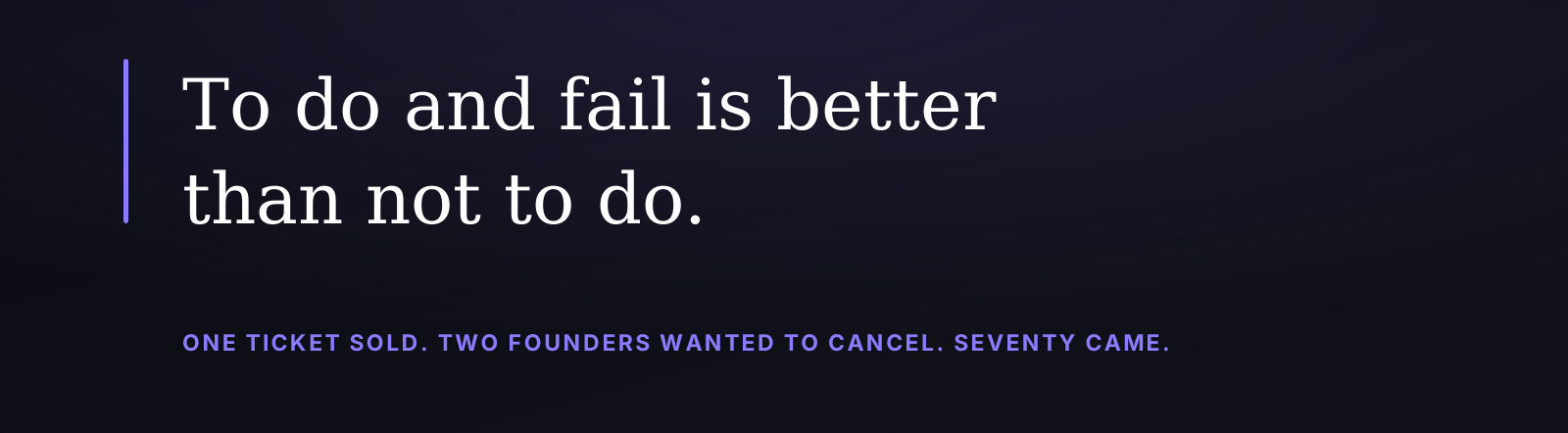
"I genuinely believe in life there are two options — to do and fail is better than not to do."
Seventy people came.
The story
Sparsh is the connective tissue. He and Gautam did four years of engineering together as undergraduate batchmates. He knew Abhishek separately, from a Toastmasters club in Delhi. By May 2023, work and circumstance had put all of them in Bangalore.
He hosted a musical gathering one weekend. Around 30 to 35 people, all passionate about music, none of them there for any particular reason.
Gautam's account of the evening is the honest version of an origin story — nobody knew what they were starting, because they were not starting anything:
"Sparsh was the only person I knew... there was Karishma, and I had known none of them back then."
Afterwards they noticed jam culture picking up around the city and wondered whether to try something of the sort. In July or August came the step Gautam identifies, dryly, as decisive: "a WhatsApp group — which is the prerequisite for anything."
Their first event was on 19 August 2023, at Dialogues Cafe in JP Nagar.
Abhishek had a specific reason for wanting a jam rather than an open mic. Open mics meant applying, waiting, and performing into rooms where people were not really listening — "the music is important for me, at least." Running their own event meant control over the whole thing.
About 70 people came, roughly 40 of them his own friends. And then the thing that turns an event into a community happened:
"After every one or two events, it was less about Abhishek singing, and then it became more about Let's Jam people, Let's Jam community."
Aditi arrived later, in March 2024, and describes walking into something already formed:
"This is very cool, such good people, such amazing work... people are coming, and it doesn't matter if you're hitting the notes or not. You're up there, they are there, supporting us. And people are having fun — which was the seeding point for me."
Key decisions
Decision 1 — Run the event, even with one ticket sold
The third event nearly did not happen. By then, friends had been called on twice and were tired of coming — so they built the event around Shah Rukh Khan's birthday, since all of them are fans.
By the Saturday evening before, they had sold one ticket. To a friend of Sparsh's. Abhishek and Sparsh wanted to call it off.
Karishma's position was that failing publicly beats not trying, and she carried it. Seventy people turned up.
"We didn't even know actually how it happened. We didn't even know how many tickets we had. But we were on stage, and there were 70 people there."
Decision 2 — Solve the problem in front of you, then the next one
Karishma is a backend engineer, and her route into running the operation is a study in how responsibility actually accumulates.
"I was always a problem solver. If you give me a problem, or a goal, I will complete that."
She started by doing ticketing and calling friends for the first event. Then "after two or three events, problems started coming" — décor, ticketing, venue. Her instinct is the whole job description: "I can't sit on a problem."
She had not been near ticketing for seven or eight months. When she finally looked at how it was being handled: "it was bizarre. It was a lot of paper pens. So I was like, I'll solve this problem."
Venue sourcing followed the same pattern. Dialogues first, then a rooftop, then problems with the speakers by the third event. So she went out and found venues herself — through LinkedIn and Instagram, reaching out directly.
And a piece of self-knowledge worth quoting in full, because it is unusually honest:
"To lead something, you have to be a little louder than other people... I am not the smartest person, but I will learn. But first I have to learn to speak up — even if I have a good idea, I have to speak up."
Decision 3 — Choose performers for expression and selflessness
Asked why Aditi in particular joined, Abhishek names two things, and neither is technical ability.
The first is expression. "I was a big sucker for expressions." His theory of where emotion in singing comes from is disarmingly simple — someone recently asked him how you get emotion into a song, and his answer was that it is the same thing that is already in ordinary honest speech. "That emotion, which is your honesty, that is the best in your songs."
The second is selflessness: "you know that you are talented, you can sing all the songs — but then you can leave it, so that you can create space for others."
Decision 4 — Take the music to the street
The busking experiment started as a bet between Karishma, who thought it would work, and Abhishek, who thought they would fail. The stakes were comic and absolute: whoever was wrong would defer to the other permanently.
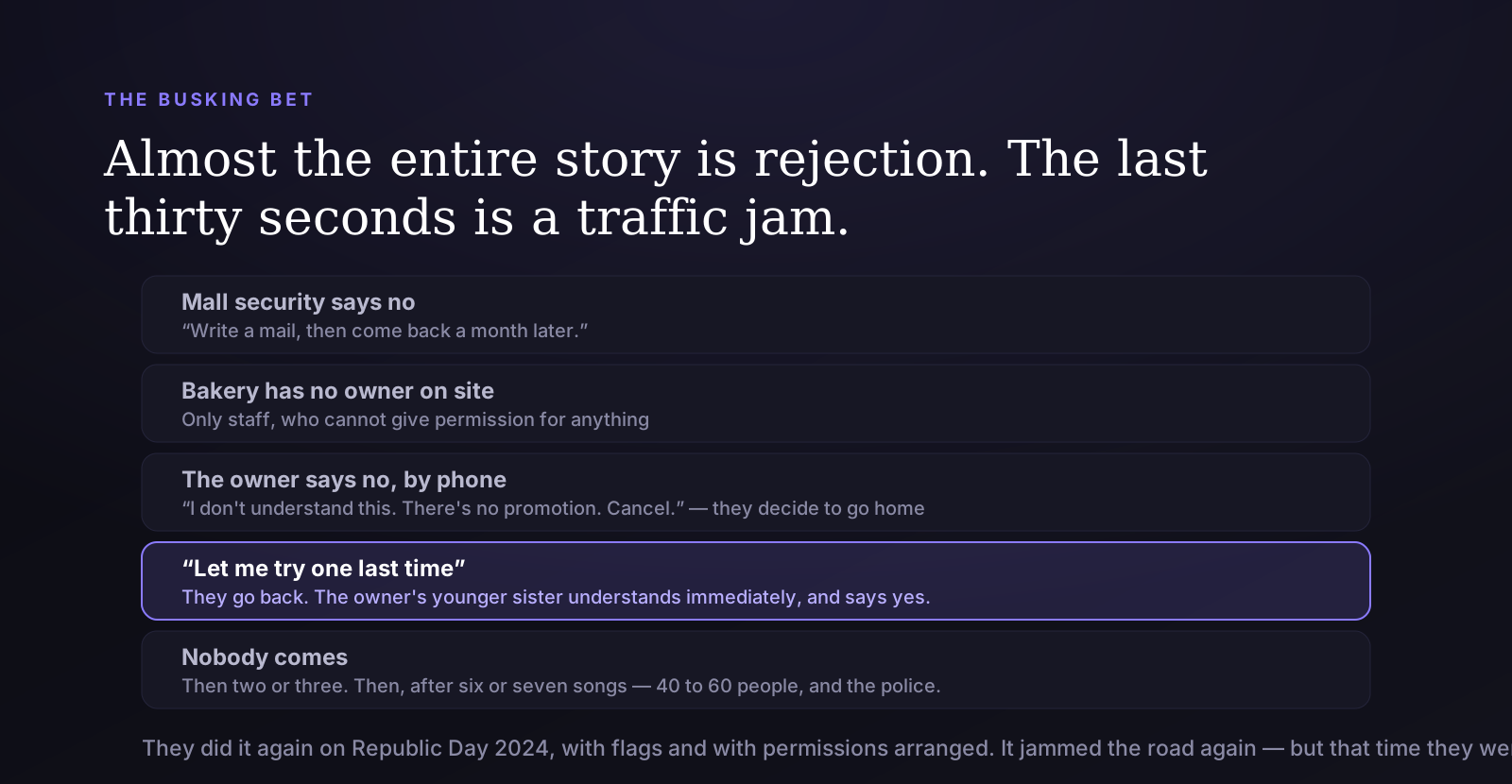
What followed is the most instructive sequence in the episode, because almost all of it is rejection.
They set up outside a mall with a camera and a guitar. Security refused — write a mail, come back in a month. Sparsh, who is "very good at talking to people and convincing them", could not move them.
So they walked to AECS layout. There was a bakery beside Karishma's dance class. The dance class agreed. The bakery had only staff on duty, so they phoned the owner — a woman in her late forties — who said she did not understand what this was, there was no promotion in it, and no.
They decided to go home. And then:
"Let me try one last time."
They went back, found the owner's younger sister, who understood immediately what they were trying to do, and said yes.
Then they started singing, and nobody came. Then two or three people. Then, after five or six or seven songs, a group of boys. Then others.
"In 30 minutes, 40 to 60 people... people started to sit on the fence. It was almost a traffic jam."
They had to talk to the police, because it was a main road. They did it again on Republic Day 2024 — with flags, and with permissions arranged in advance. It caused a jam again, but this time they were ready for it.
"So it was Let's Jam leading to a jam."
Mental models
Nostalgia as the organising goal
The strategic turn came from an outsider asking questions they could not answer. A founder who had come to sing sat them down and asked, essentially: what is this?
"Are you a band? Are you trying to create a platform where people come to perform? What is it exactly?"
Abhishek's answer was both — "we are a band, because we are our own voices, but then we are opening up also." But the word that came out of that meeting and stuck was nostalgia.
His reading of the audience: Bangalore holds a large Hindi-speaking population who are nostalgic both for home and for the nineties and two-thousands. So nostalgia became the explicit goal of a set — songs, advertising jingles and TV serial themes chosen for maximum pull.
Singability, then danceability
The KPI framing is the sharpest transfer of product thinking into a creative form, and it operates per-event and per-phase.
For a room of 500 or 600, the metric is singability — how many people can actually sing along. Which rules things out: "we don't want to do highly technical songs... we do less obscure songs which people can connect with."
Then, for the closing stretch, the metric changes entirely: "for the last few minutes, the KPI is not singability, it's danceability. That is what Aditi takes care of."
Underneath both sits a flow he arrived at by trial: slow, medium, then fast. Early sets were simple medleys over one or two chords, until "very soon I realised there has to be a flow of energy."
The performer's enjoyment is a constraint, not a luxury
The counterweight to optimising purely for the crowd, and the reason the sets do not become mechanical:
"I want to enjoy my singing. So I'd probably pick more songs where singability compromise is also happening — songs that I have sung less, but which I enjoy."
He asked Gautam to do the same exercise: list fifty songs you have loved across your entire life, and pick from that list. His justification is a claim about transmission — "if you enjoy it, you transfer it in the mood feeling. When we get to enjoy it, the audience gets it too."
Accompanist or sangeetkar
Gautam's contribution on what makes a stage work, and the most quietly generous idea in the conversation.
"An accompanist can feel like a sidekick. But Abhishek's hidden talent is that he makes the group feel like a sangeetkar. You don't feel like you're accompanying someone — you feel part of the process."
And the consequence: "when the energy flows on the stage, it will flow there [to the audience]. If it's missing here, it will never reach there."
The audience connection everyone talks about is downstream of a connection between the players that the audience never directly sees.
Frameworks
Framework 1 — The four principles, arrived at backwards
Abhishek's reflection when asked whether product thinking applies. He had not framed it this way before, which is part of what makes it credible.
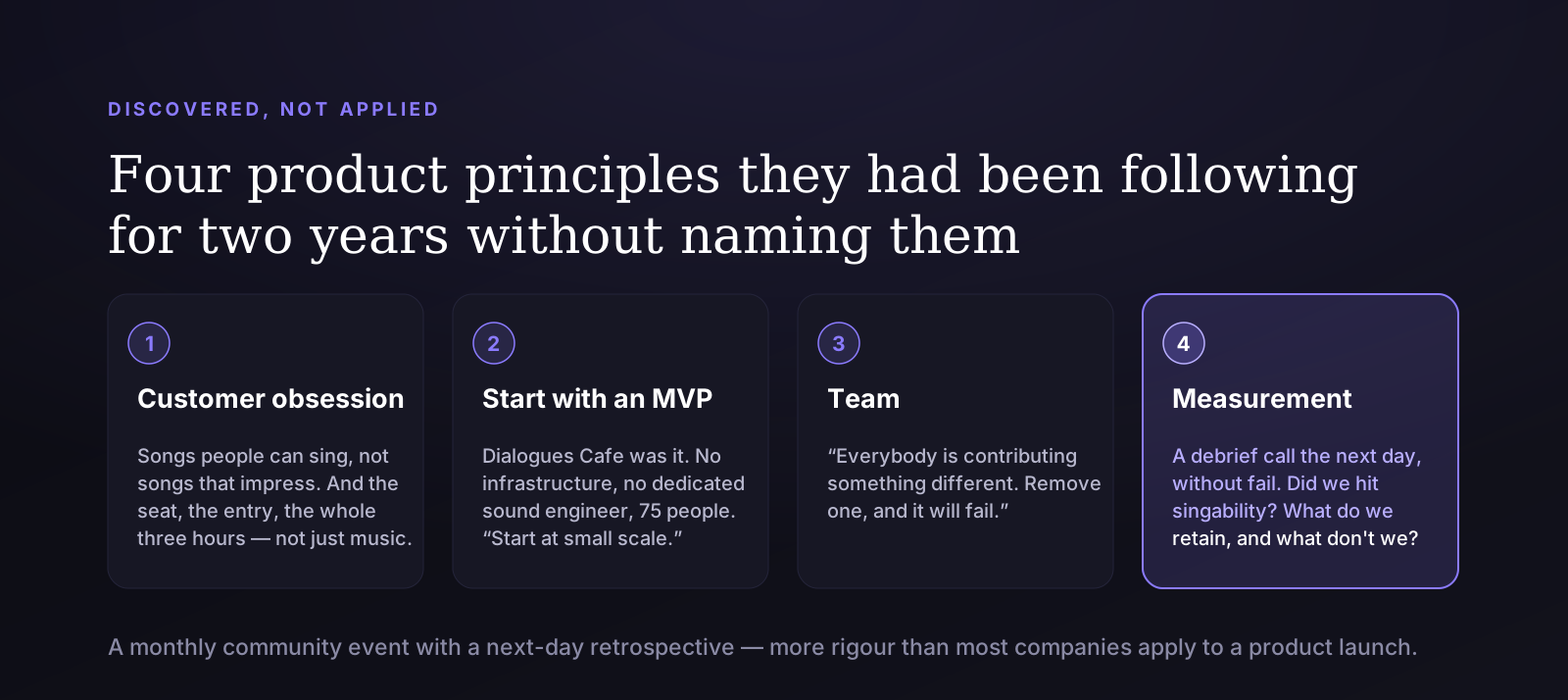
Customer obsession, in two parts. The setlist — chosen for connection rather than technical ambition. And the experience beyond the music entirely:
"Experience is not just the music. You get the seat, you get the cover charge, you get the entry. The entire customer journey and the experience is our responsibility in those three hours. We handle it on stage, they handle it off stage."
Start with an MVP. Dialogues Cafe was it. "We did not have so many people, we did not have so much infrastructure, we did not have a dedicated sound engineer. Start at small scale."
Team. "You have a product guy, an engineer, an analytics guy. Everybody is contributing something different. Remove one, and it will fail." Gautam makes this concrete about Karishma: "we are very skeptical to do an event when she is not there — because it's not just what's happening that day, a lot of inflows from before."
Measurement. The part they had not mentioned until asked, and the most disciplined thing about the operation:
"Without fail, after every Let's Jam, next day we have a debrief call. What went well, what did not go well. The KPIs and singability — were we able to achieve that? So that we know what to retain and what not to retain."
A monthly community event with a next-day retrospective is more rigour than most companies apply to a product launch.
Framework 2 — The lean way, demonstrated on sound
Their equipment story is the clearest argument for incremental investment anywhere in the episode.
"With the sound, I didn't have any idea. Someone says tops and subs — I don't understand. Because one speaker, what is the idea of the subs?"
Today they run professional-grade equipment. And Abhishek's point is not that they arrived — it is what the arrival looks like from outside:
"It becomes sophisticated... it becomes an entry barrier."
Someone looking at Let's Jam now would reasonably conclude they need that gear to begin. They did not. They needed a cafe and a cajón.
"If we want to start something, just start it. Start it — it's good, it's bad — but then you'll figure out your mistakes and move forward."
Framework 3 — Consistency over scale
"You can't do 1,000 people at the first event. First event, 25 to 50 people."
He points at his own YouTube channel as the same curve: the first video got a thousand views, the second rather fewer.
"The magic that you see is consistency — that you are continuously doing something."
They run an event every month, "busy or otherwise", and improve it slightly each time. The improvement is the point; the schedule is what makes the improvement possible.
Lessons
Gautam's musical education began as crowd control. His grandmother played sitar, his father tabla, and the house was full of classical music — but nobody pushed him toward it. He was "an extremely notorious kid", and his mother enrolled him in music class in second standard purely to divert his energy and get some quiet.
He studied classical for two years under a teacher then in her seventies, then Hindustani classical from fifth to eighth standard. When his voice broke at puberty, his teacher suggested a break — and there happened to be a tabla class in the same building. He tried it and initially did not enjoy it.
Then, in eleventh standard, someone handed him passes to a Zakir Hussain concert.
"When I saw the magic on stage, what is possible with this instrument, I was like — I am never leaving this. That one evening with Zakir Bhai was enough for me."
His summary is lovely and worth keeping: "it was not a conscious effort from my side. It held on to me." And: "the fact that I'm here is because of the mischief when I was a kid."
Abhishek describes himself as an audience first. "I'm more than a singer, I'm a listener." And, more precisely, "I'm a mimicry artist" — learning by copying what he heard.
What actually drives him is emotional processing rather than performance. Songs and poetry "always come when my heart breaks... I thought, how do I explain it, how do I fill the void?" On stage he is still doing that: "it's very internal for me."
In college he started Roadside Versions, a YouTube channel for covers — recording musicians better than himself. His own first stage performance was at Hindu College, opening for the band Parvaaz in front of around 500 people, singing covers. He started his own channel in July 2022, after moving to Bangalore.
Aditi never trained formally at all. Her father's job moved the family often, so she never held onto a teacher long enough. "I've honed my skills in the bathroom while shouting."
She shares Abhishek's method — "both of us are better mimicry artists than singers" — working from questions like how did Shreya do this harkat, why can't I do it? And she names the faculty that makes it possible: kaan, the ear. "For some people you need to clean it, for some it comes naturally, and touch wood it came naturally to me."
Nobody is doing it for money. Aditi's closing thought: "None of us are in it for the money... capitalist mentality is lesser. But to make it bigger — how can we do it better?"
And what she names as the actual competitive advantage is not a song or a venue:
"The sync that all of us have together. We have subtle eye contact with him and we just understand. It's a well-oiled machine. That's our USP."
Actionable advice
If you are waiting for the right conditions: run it anyway. One ticket sold is not a reason to cancel — it is a reason to find out.
If you are building a community: design for participation, not display. Pick the things people can join in with, and measure whether they did.
If you are choosing collaborators: look for expression and generosity before technical ability. The person who makes room for others changes the whole group.
If you are intimidated by the gear: the sophistication you see is the output of years of incremental spend, not the entry ticket. Start with what is in the room.
If you want it to compound: pick a cadence you can hold and improve slightly each time. Consistency is the mechanism; scale is the result.
And whatever you are running: hold the debrief the next day, while it is still fresh, and write down what to keep.
Final thoughts
The most useful thing in this episode is what happens when the host asks whether any product thinking applies to a music community, and Abhishek pauses, reflects, and finds four principles he had been following without naming.
That order matters. He did not read about customer obsession and apply it to setlists. He noticed that highly technical songs left the room silent and less obscure ones got everybody singing, and reorganised around that. He did not decide to launch an MVP — he had a cafe, no sound engineer, and did the event anyway. The vocabulary arrived afterwards to describe what had already worked.
The busking story is the same shape. A mall's security says no. An owner says no. They decide to go home, and then someone says let me try one last time, and a younger sister says yes, and forty minutes later there is a traffic jam that needs police attention. Nothing about that is strategy. All of it is a willingness to be told no six times and knock once more.
Which is presumably why the group's own answer, when asked what makes it work, is not the setlist or the KPIs or the equipment. It is the eye contact — four people on a stage who can read each other without speaking, doing this around their day jobs, for no money, every single month.