Endurance, enterprise & excellence
Rishi couldn't swim 50 metres at 38. Two years later he finished a full Ironman. Twenty years at one company, four Ironmans and two thousand books later, his method turns out to be the same one every time.
Watch the full episode on YouTube
Executive summary
Rishi is an enterprise leader at Nokia, where he has just completed twenty years — a company he joined when it was Alcatel, watched become Alcatel-Lucent, and then Nokia. He is also a four-time Ironman finisher with, by his own admission, an uncounted number of half-Ironmans behind him. He has travelled 28 countries, reads one to two hours a day, and owns somewhere around two thousand books across two libraries in his home.
The obvious question is how one person does all of that. His answer refuses the premise:
"It is not that you lack time. It's that you lack priorities."
And underneath that, the sentence he keeps physically in front of his desk:
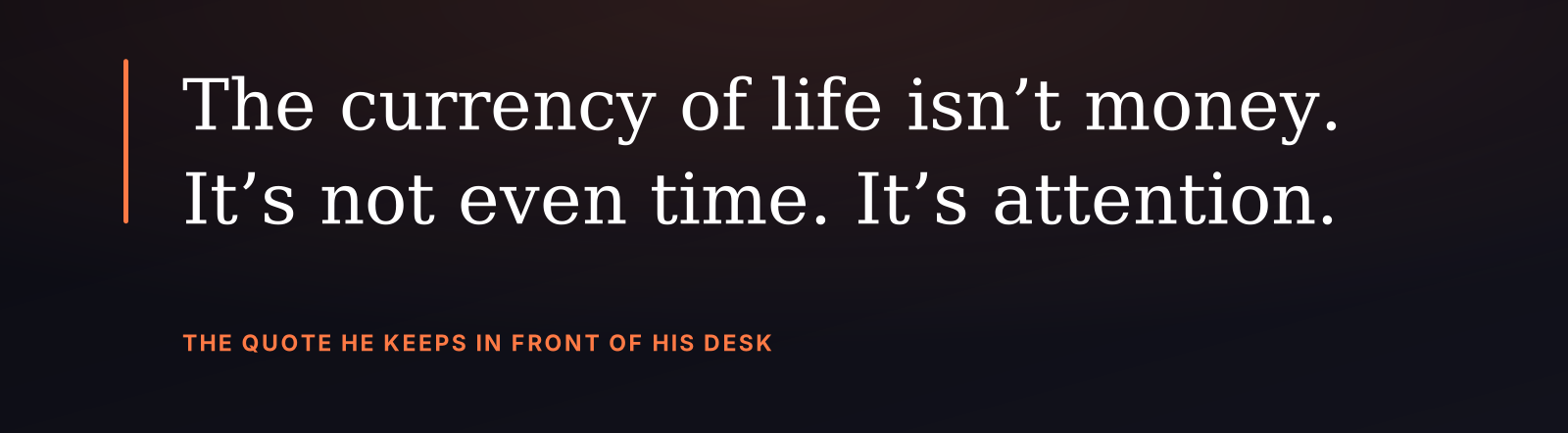
"The currency of life isn't money. It's not even time. It's attention."
What makes the conversation useful rather than merely impressive is that the method behind each of his three lives is identical, and unglamorous. He does not attempt more than others; he declines more than others — "my not-to-do list is bigger than my to-do list, and I'm very proud of my not-to-do list." He does not push through pain; he refuses to get injured, because consistency is the only real variable and injury is the only thing that reliably ends it. He does not read to finish books; he reads with a pencil, goes deeper rather than wider, and lets the reading turn into obsession.
Three ideas here transfer directly into any career. The 33/33/33 split explains why most ambitious goals fail, and it is not the reason people assume. The default-trust position, calibrated at roughly 80%, is the most honest account of managerial trust in this whole series. And a single race in Italy — where he lost 35 minutes to fear in the water and still set a personal record by 90 minutes — is the cleanest demonstration you will find of what "focus on the present" actually costs and pays.
The story
He was 38, and he had just climbed one flight of stairs.
"I was running from one meeting to another, and because I was late I rushed through the stairs instead of taking the lift. Of course, it was only one floor. But I was panting. I was panting very badly."
That was the first trigger — a "very stark visual reminder of how unfit I was." He had gone from a thin 60kg in college to somewhere past 90kg; he says he stopped weighing himself after 90 and does not actually know where he peaked. Corporate life had done what corporate life does: free meals, air conditioning, a chair. And his first child was on the way, which raised the stakes on the arithmetic.
The second trigger was a coffee.
He and a friend were talking in the cafeteria one afternoon when someone mentioned a person who had completed an Ironman.
"We were like — yeah, this sounds very cool. There was no greater thought behind this. It sounds very cool, and it sounds very impossible. And I was 38 then. I said, wow, this can be a great thing to do before you turn 40."
Here is the honest inventory at that moment. He could not swim 50 metres. The longest he had ever run in one go was 7 kilometres — which took him 50 minutes and left him needing a week to recover. An Ironman is a 3.8km swim, a 180km ride and a full 42km marathon, back to back, in a single day, without a break.
June 2016 to June 2018. Two years. He finished his first full Ironman in the Philippines, two months before his fortieth birthday.
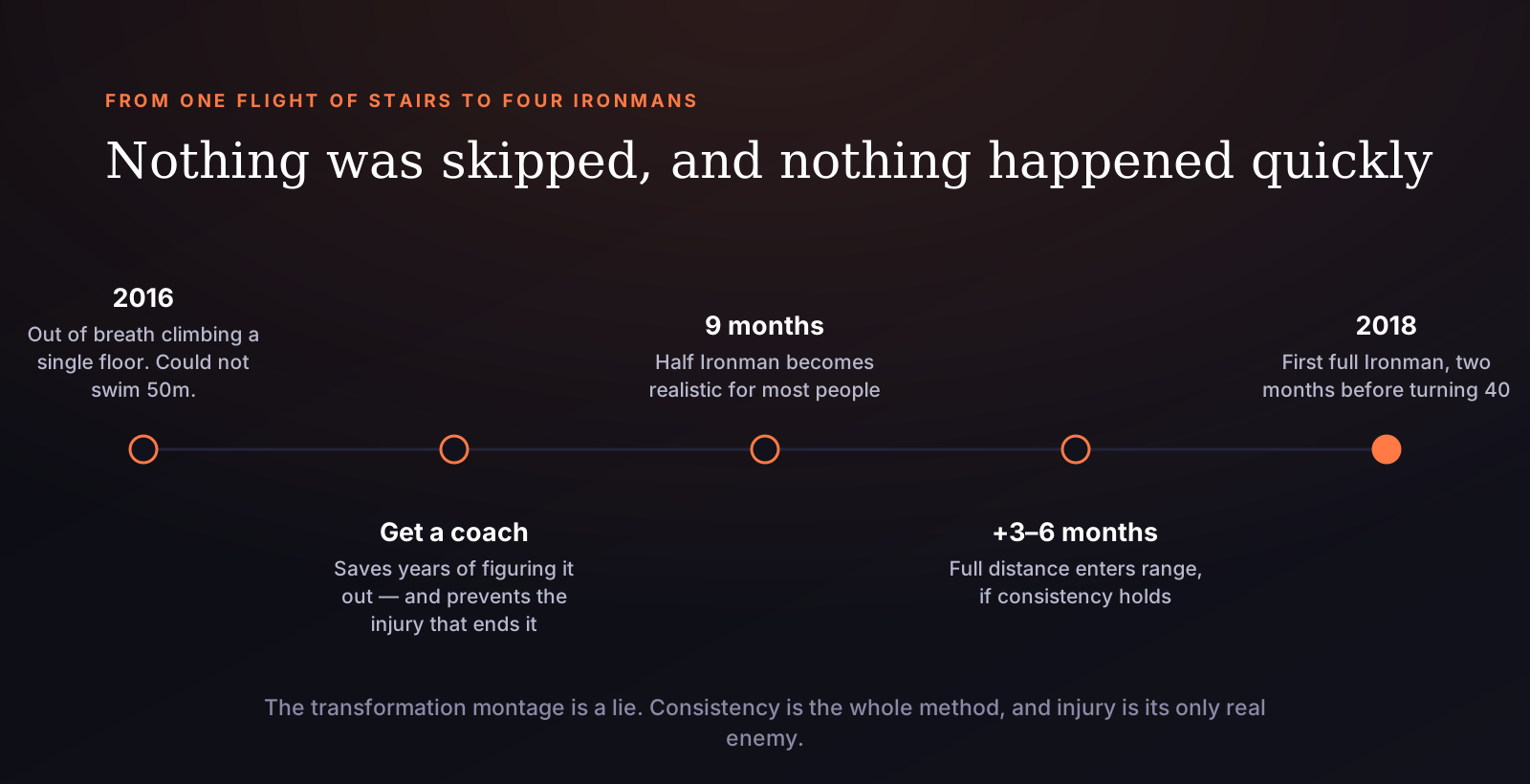 The montage is a lie. Every stage was ordinary, and none of it was skipped.
He is emphatic that nothing about this was heroic, and unusually specific about why people fail at it:
"Most of the beginners, when they see that transformation happening in one song, they believe the transformation is an overnight transformation."
The real timeline is boring and available to almost anyone: six to nine months to a half Ironman, another three to six months to a full — "those things are possible." But two things gate it. The first is a coach, "because a coach will save you years of figuring it out on your own" and, more importantly, will keep you from the injury that ends the whole project. The second is consistency, which depends entirely on the first.
"The most important thing is you have to be consistent. And to be consistent, the most important thing is you cannot get injured."
The corporate half of his life runs on the same logic. He graduated from NIT Jalandhar, started in Bangalore in 2000 at Bell Labs as an embedded engineer, and spent five formative years there — "whatever I know on TCP/IP stacks, Unix and all, it's from those years." Then a move to Delhi to be near his parents, and the company that became Nokia.
One early choice is worth studying, because it is the same not-to-do-list instinct applied to a career. He moved from development into QA, deliberately, and his reasoning was not passion:
"Very selfishly, I clearly saw that good people all go into development, and very few good people by choice go into QA. And I think you have to be smarter than the developers if you have to be a good QA. Also, because very few people were going there, I said — okay, this is the road where very less competition is there, and I can add a lot of value."
Then the transition that he says he was completely unprepared for. His first manager at Alcatel "somehow had a lot of trust in me" and moved him into people management quickly — "which I was not prepared for, not at all interested in. I never ever thought I would become a people manager."
What he learned there is the thing every strong individual contributor eventually collides with:
"As an individual contributor you are in charge of doing everything by yourself. And it's very, very difficult to let go of charge. It's very difficult to trust other people that they will do the job as well as you can do — and even realise later that they can do the job much better than what you can do. But it does not come easy. It takes a lot of self-assurance. It takes a lot of trust in people."
His account of every success since is consistent to the point of being repetitive, and he does not seem to notice he is repeating it: "It's all because the team came together, honestly. I just enabled them."
Key decisions
Decision 1 — Maintain a not-to-do list, and make it the longer one
This is the organising decision, and everything else is downstream of it. He trains 10 to 12 hours a week, reads one to two hours a day, travels, and has a demanding job and two children — one in class 12 preparing for entrance exams, one aged eleven.
His explanation is not a productivity system. It is a refusal:
"I am very mindful of where my attention goes. My not-to-do list is bigger than my to-do list, and I'm very proud of my not-to-do list."
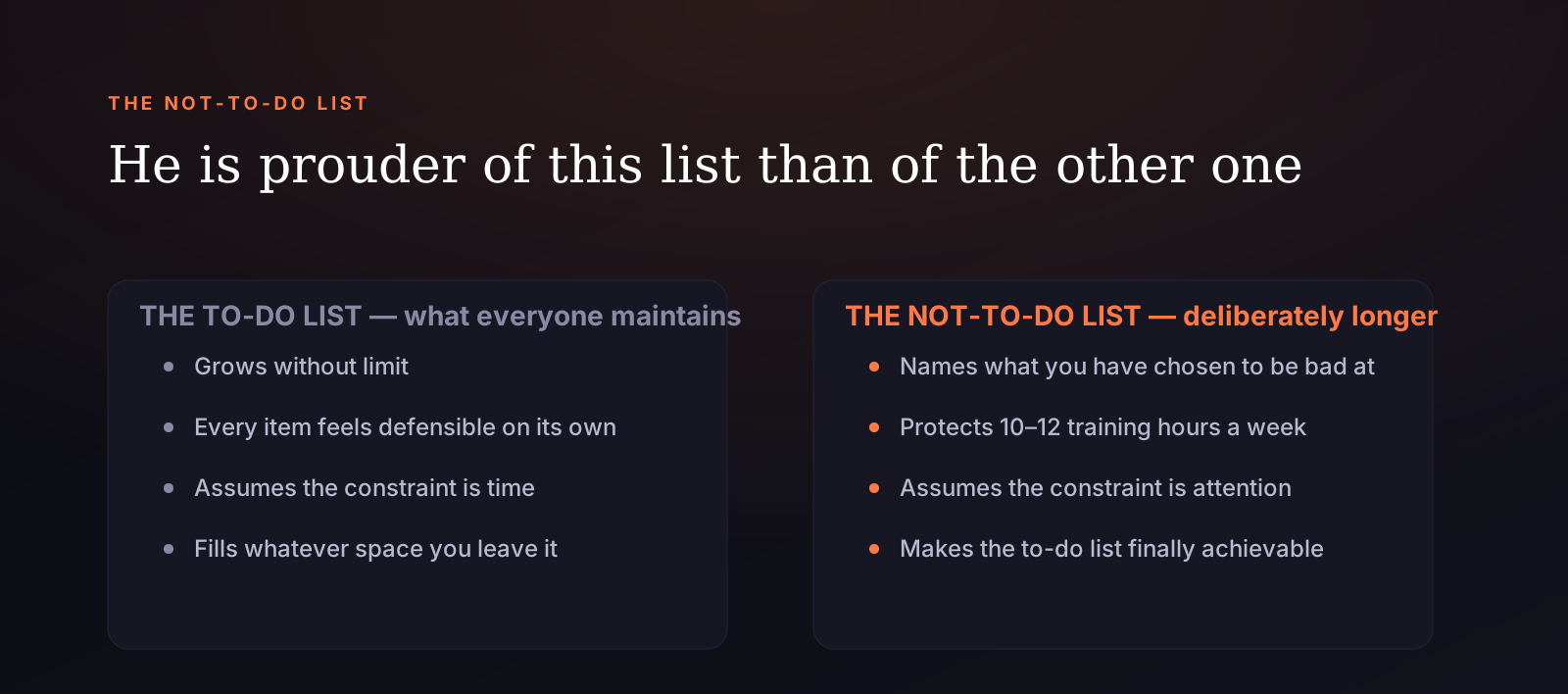
The reframe that makes it work is the distinction between time and attention. Time can be found — he is casually dismissive of the idea that he lacks it — "I always tell people I have a lot of time." Attention cannot. A to-do list assumes the constraint is hours. A not-to-do list accepts that the constraint is what you are willing to be bad at.
"We are sitting here and I have already done my two workouts."
Decision 2 — Default to trust, at about 80%
Asked what he does when someone on the team could be doing better, his answer is the most calibrated version of this idea in the series — because it includes the failure case, which most leaders leave out.
The starting position:
"My default position is trusting people. And I have learned that by and large, people repay the trust by doing more than what they are capable of."
The qualifier that makes it survivable:
"Corporate teaches you — do not expect everyone to be your own reflection. It's very human to expect that if you can do something well, why can another person not do it well. Everyone comes from a different background. What matters to me most is: are they doing the best of what they are capable of?"
That is the actual standard. Not output relative to you; effort relative to their own ceiling. Someone might be a 10x engineer and someone might not, and he treats that as a fact about the world rather than a verdict on the person.
And then the limit, stated plainly:
"If someone is not doing the best they are capable of — if they choose to watch Netflix while sitting in office or browse YouTube — those people do not last with me for very long. You cannot be stupid. If someone is abusing this, you are giving a very bad signal to other people who are doing good work."
His summary: "Default trust — I would say 80% it has paid me fantastically well." Not 100%. Eighty. A default, not a doctrine.
Decision 3 — Push people past their own estimate of themselves
He describes the leaders he learned from as holding two things in tension that most managers treat as alternatives.
The first is safety: "very empathetic, very understanding people. They would give you their trust. It is very liberating to work with someone who has your back."
The second is pressure — "but they have also pushed me to do something which I might not have felt I was capable of doing."
He anchors it in Josh Waitzkin — the chess prodigy who later became a world-class competitor in push hands and now coaches — and his book The Art of Learning:
"He says one very critical component of learning is that you have to push constantly a little more than what you think you are capable of."
The synthesis is the thing worth copying:
"They had this great balance of being very strongly in your corner, strongly defending you and fighting for you with the world — but still pushing you a little more than what you think you're capable of."
Defence without pressure produces comfort. Pressure without defence produces attrition — and he is blunt about the consequence: "People do not leave a company, they leave their managers."
Decision 4 — Translate the corporate vision into individual currency
The clearest change he identifies in his own leadership over twenty years, and it arrived as he moved closer to the business side.
"There is a vision which the corporate has laid down. But people do not work for a vision. People work for their own passion. They work for something they believe in, something which will bring them happiness and which will bring them value in their own skill. It's very human nature."
So the job became translation:
"I understand the power of setting up the right leverage and the right incentive much better — and communicating the corporate vision to how it goes at an individual level. What is in it for me?"
He is careful that this runs in both directions, and the test he applies is a genuine win-win:
"If you are growing and the corporate is not growing, it is not a win-win. And if the corporate is growing but you are working on technologies which are completely obsolete, it is not good either."
Decision 5 — Buy recovery, not gadgets
He treats recovery as a discipline rather than an afterthought — "Ironman is four parts: swim, bike, run and recovery."
What he actually does: 80% clean nutrition, self-education on carbohydrates, fats and proteins, and blood work every six months as an objective indicator of whether things are going fine.
And then a dismissal of most of the industry that is worth quoting in full:
"There are a lot of supplements, there are a lot of compression boots and all. Nothing works. If that's 1%, a good sleep and good nutrition are 99% of the recovery. Rest are people trying to sell you stuff."
Then the observation that explains the whole market:
"No one can sell you sleep. No one can sell you homemade food. That's why these are not popular — incremental gains are popular."
Mental models
The 33/33/33 split
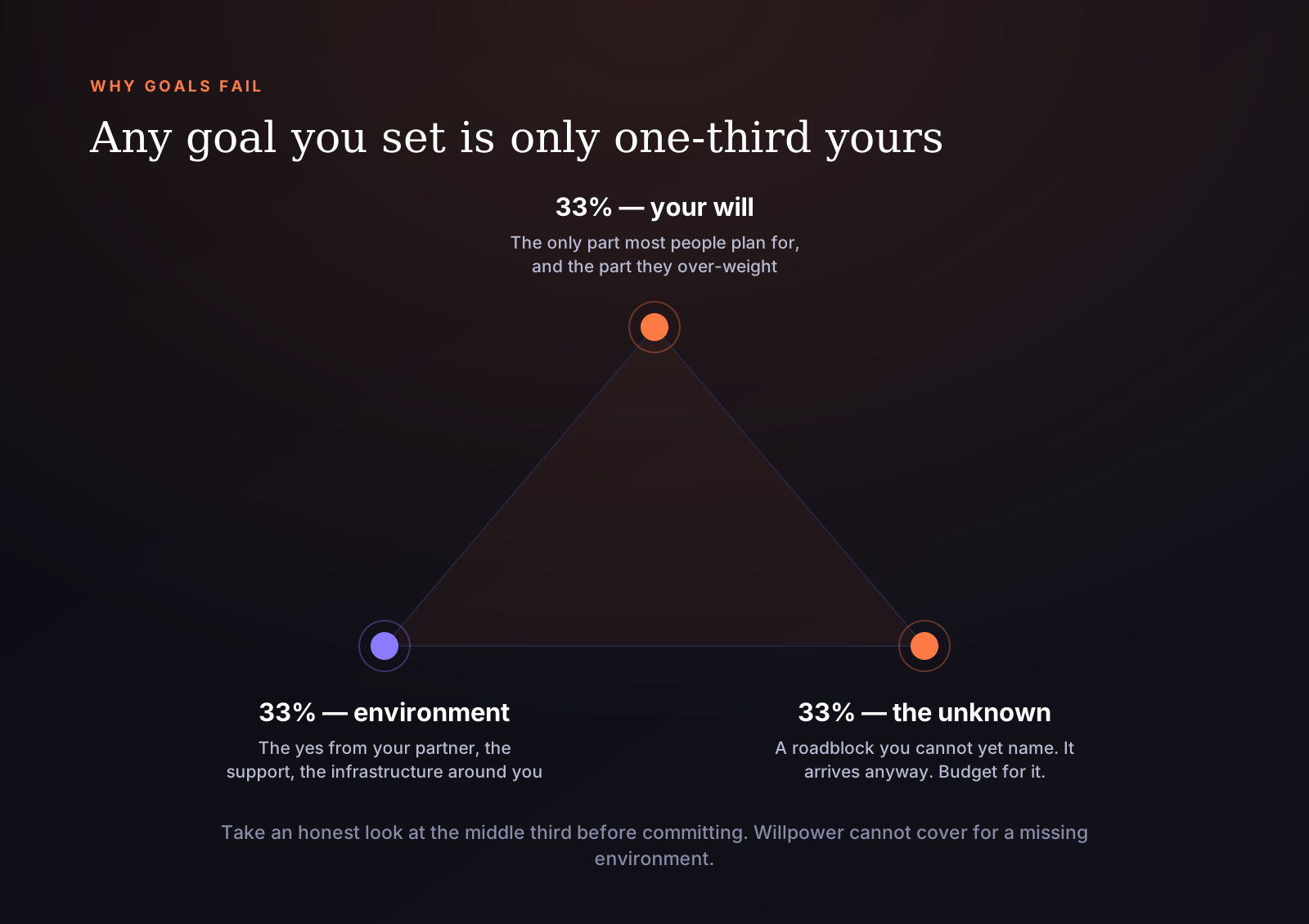
From a goal-setting workshop he had run shortly before the conversation:
"Any goal you are setting — 33% is your own will, 33% is environment, and 33% is what you do not know yet. Some roadblock will come in life."
The middle third is the one that quietly decides outcomes, and he makes it concrete rather than abstract. Training for an Ironman requires "a yes from your partner" and an infrastructure around you:
"Let's say your job is very hectic, and your wife's job is very hectic, and there is no one to take care of the child — it would be extremely difficult to take on something like Ironman when you do not have the infra. If you want to do this thing, you need to create the infra."
Apply it: before committing to a large goal, take an honest look at all three thirds. You control the first. You can build the second, but only deliberately and usually in advance. The third will arrive regardless, so leave slack for it. Willpower cannot cover for a missing environment, and most abandoned goals are environment failures that get filed as discipline failures.
Focus on the next unit, not the race
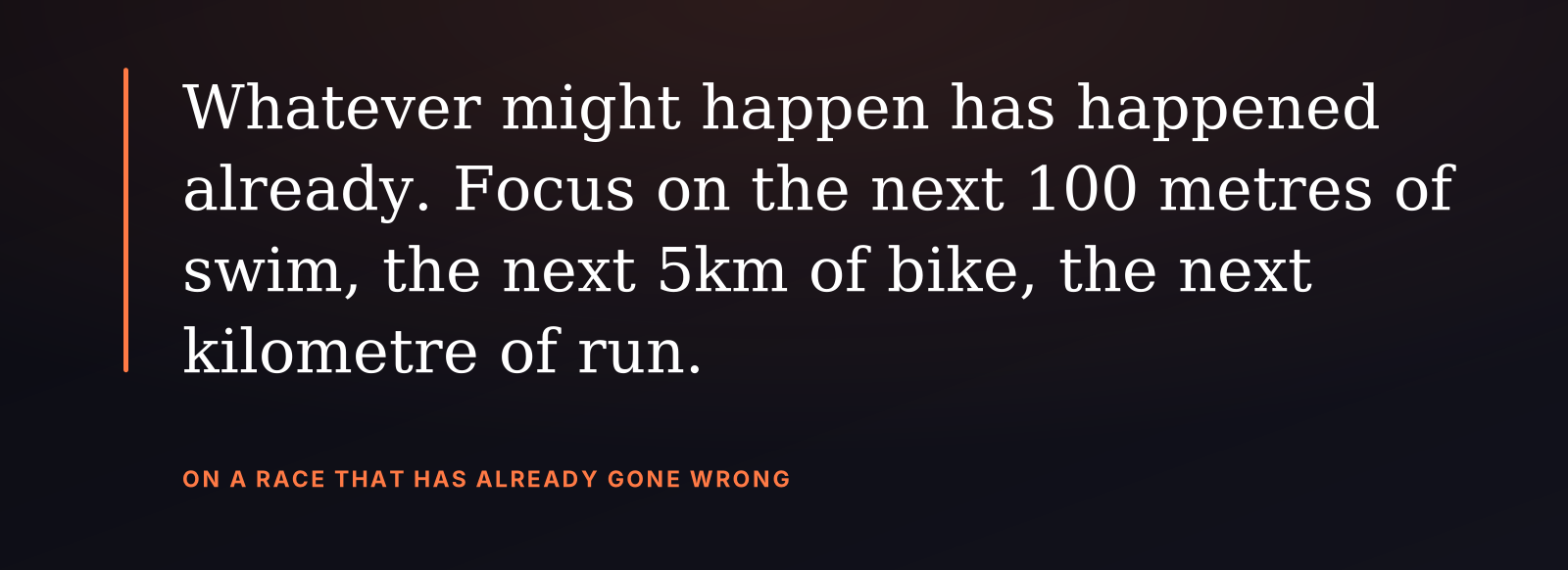
He calls this answer "very boring, very simple" and then produces the single best illustration of it in the series.
At Ironman Italy, the swim went badly wrong. "I got paralysed by fear." He took 2 hours 5 minutes in the water. His previous two full Ironman swims had taken 92 and 90 minutes — so he was 35 minutes behind his own plan before the day had really started.
The decision at that moment is the whole model:
"Do you think back on what has happened, or do you consider that what has happened has happened, and focus on the present? What has happened, you cannot change. You can spoil your present and future thinking about the past."
He ignored it. He then rode his fastest-ever bike split and ran his fastest-ever run split — and finished with a personal record by 90 minutes.
The reason the discipline matters over a 10-to-12-hour day is mechanical, not motivational: "More than that, you're driving yourself mad, because it's an extremely long day." You cannot carry a bad first hour through eleven more.
He backs it with Scott Adams: "The past has happened. It is gone. There is no meaning to it any more than what you want to attach to it."
And the transfer to ordinary life is immediate — the practice is the same one, and it is trainable: "This is a practised skill. You improve on it if you do it constantly."
The life résumé
Years ago he read something that stuck: build a life résumé, not just a professional one.
The professional discipline came first, and he still gives the advice to others: update your résumé every six months, and "if there is no update in the last six months for two consecutive times, you should look at some other opportunity — because it means you are not growing."
Then he applied the same test to everything outside work. Twenty-eight countries, four Ironmans, two libraries — these are not hobbies competing with his career. They are entries on the other résumé, held to the same standard of did anything change in the last six months?
Learning as an expanding hole
His reading is not a habit so much as a compulsion, and its mechanism is worth naming.
He has been a reader since he was ten — fiction almost exclusively for the first decade or two, then non-fiction. Recently: "last week I was reading a wonderful book called The World for Sale*, and I learned how oil trading and grain trading work at a world level. Now I'm reading a book on how cargo ships work."*
Then the mechanism:
"When you learn all this, you first learn how much you do not know. And then the learning becomes an obsession. It's like a puzzle you want to solve."
Two refinements he has made over time. First, depth over breadth — he now goes deep on one area for extended stretches: the brain, then human psychology, and for the last year and a half, finance. Second, no quotas. He reads every day but refuses page targets: "it will take the joy out of my reading, and I really enjoy my reading."
His method is physical and interactive — pencil in hand, underlining, adding his own thoughts in the margin. He tried Kindle for a few years, under what he describes as an ultimatum about running out of space at home, and came back to paper. Not for nostalgia, but for function: a stack of physical books on the table stays visible, and "it becomes so easy to open the book, see your underline, and build your story."
Travel without a checklist
The same refusal to optimise shows up in how he travels. No agenda, no list of sights — "I really do not bother if there is some world-famous site there. I can care less." What he wants is to watch how locals go about an ordinary day: walk the city, buy an ice cream, keep walking.
The best story in the episode comes from this. Checked out of his hotel in Prague with nowhere to be, sitting in the lobby, he opened Google Maps and zoomed out to see what was nearby. He saw a place called Bratislava — a city he had never heard of — an hour away, with a train.
He took the train.
"When I reached there, I learned that Bratislava was a former Soviet bloc part. And honestly, the first 500 metres were very shady. Very, very shady. The station was very old, the streets were full of graffiti. I was like — damn, where did I come?"
That night he went out to find food and ran into a crowd of college students. He started talking to them, and discovered that Bratislava is one of the most popular places in Europe for the student crowd because it is cheap. He spent two hours in conversation with them.
"Of my whole Europe vacation, Bratislava is the most memorable trip I had. I love the serendipity of it. I do not go with a checklist."
The pattern holds: the value was in the part that could not have been planned, and would have been optimised away by anyone with an itinerary.
Frameworks
Framework 1 — The Ironman progression
What it actually takes, from someone who started at zero.
| Stage | What it requires | Why it matters |
|---|---|---|
| Get a coach — first | Before any training plan | "Saves you years of figuring it out on your own" — and manages the progression so you don't get injured |
| Consistency | The only real variable | Everything else is downstream. Injury is the one thing that reliably ends it |
| Build the environment | A genuine yes from your partner; support at home | This is a third of the outcome, and it cannot be willed into existence |
| 6–9 months | Half Ironman becomes realistic | For most people starting from ordinary fitness |
| +3–6 months | Full distance enters range | If consistency has held throughout |
Note what is missing from the list: talent, motivation, and pain tolerance.
Framework 2 — The trust ladder for managers
How he actually calibrates trust, including the ceiling.
- Start at trust. Default position, not a reward that has to be earned first.
- Judge against their ceiling, not yours. The question is whether they are doing the best of what they are capable of — not whether they match you.
- Expect it to be repaid. "By and large, people repay the trust by doing more than what they are capable of."
- Hold the line when it is abused. Not for the sake of the person abusing it, but because tolerating it signals to everyone else that their effort is optional.
- Accept 80%. It will not work every time. It works often enough that the alternative — defaulting to suspicion — costs more.
Framework 3 — Defend and push
The two-sided leadership posture he learned from the managers he stayed twenty years for.
| Doesn't push | Pushes past their estimate | |
|---|---|---|
| Has your back | Comfortable. People stay and stop growing | ✅ The combination worth copying — safe enough to attempt, stretched enough to grow |
| Doesn't have your back | ❌ Neither safe nor stretching — people leave | Brutal. Growth extracted at the cost of the person |
The upper-right quadrant is not a compromise between the two axes. It requires both at full strength, which is why it is rare.
Framework 4 — Reading that compounds
- Go deeper, not wider. One domain for an extended stretch — a year or more.
- Read interactively. Pencil, underlines, your own thoughts in the margin.
- Keep the current stack visible. Physical books on the table you can reopen to your own notes.
- Run a lighter book alongside the heavy one. A 700-page finance book and a book of poems, so a tired evening still ends in reading rather than not-reading.
- No page quotas. Daily, yes. Measured, no — the measurement is what kills it.
Lessons
Attention and priorities
- The scarce resource is attention, not time. Manage accordingly.
- Keep a not-to-do list, and be proud when it is longer than the other one.
- "I don't have time" is almost always "I haven't prioritised" — said more comfortably.
- Build a life résumé alongside the professional one, and hold both to the six-month test.
- If your professional résumé hasn't changed in two consecutive six-month checks, you have stopped growing.
Endurance and goals
- Any goal is one-third will, one-third environment, one-third unknown. Audit all three before committing.
- Build the environment deliberately and in advance. Willpower cannot substitute for it.
- Get a coach before you get ambitious — it buys years and prevents the injury that ends everything.
- Consistency is the whole method; injury is its only real enemy.
- When the day goes wrong early, focus only on the next unit — the next kilometre, the next task.
- Recovery is a discipline, not a gap between efforts. Sleep and nutrition are 99% of it.
- Be suspicious of anything marketed as an incremental gain; nobody can sell you the things that actually work.
Leadership
- Default to trusting people, and expect roughly 80% of that trust to be repaid.
- Judge people against their own ceiling, not against your reflection.
- Hold the line when trust is abused — tolerating it punishes everyone doing good work.
- Have people's backs and push them past their own estimate of themselves. Both, at full strength.
- People leave managers, not companies.
- Nobody works for a corporate vision. Translate it into what it means for them personally.
- Check that growth is genuinely two-way: the company growing while your skills obsolesce is not a win.
- Letting go of charge is the hardest part of becoming a manager, and the whole job.
Actionable advice
This week
- Write your not-to-do list. Not things you're avoiding — things you have consciously decided to be bad at so something else can be good.
- Look at your résumé. Has anything changed in the last six months? If not, that is the finding.
- Pick the goal you keep postponing and split it into thirds. Name your environment gap out loud.
This month
- If you have a physical goal, find a coach before you find motivation.
- Choose one domain and go deep for the next year instead of grazing across five.
- In your next one-on-one, ask yourself whether you are judging this person against their ceiling or against your own.
This quarter
- Take one thing you believe you cannot do and find the honest 6-to-9-month version of it.
- Build the environment for it — the conversations, the support, the infrastructure — before you start training.
- Travel somewhere without a checklist. Pick the destination on the map an hour before you go.
Final thoughts
The temptation with a profile like this is to read it as capacity — a person who simply has more energy than the rest of us, and therefore gets to have three lives.
The conversation does not support that reading. What it shows instead is a person who has been unusually willing to be bad at things.
He chose QA because fewer good people went there. He keeps a not-to-do list longer than his to-do list. He refuses page quotas because measurement would kill the reading. He skips the famous sights. He ignores the supplement industry and buys sleep instead. He accepts that 20% of his trust will be wasted. And on a day when 35 minutes evaporated in the water, he refused to spend a single further minute on it.
Every one of those is a subtraction. What looks like an extraordinary amount of output is really an extraordinary amount of declining — and the discipline is not in the training hours or the two thousand books, but in the decision, made repeatedly, about where attention is not going to go.
The Ironman is the clearest proof, because the starting conditions were so ordinary. A man out of breath after one flight of stairs, unable to swim 50 metres, who thought the whole idea sounded very impossible. What he did next was not remarkable in kind. He got a coach, stayed consistent, avoided injury, built the support around him, and then, on the day, refused to think about anything except the next kilometre.
"Whatever might happen has happened already. Focus on the present."
Rishi is an enterprise leader at Nokia, where he has completed twenty years across development, QA, programme management and support. He is a four-time Ironman finisher, has travelled 28 countries, and reads one to two hours a day.