From idea to impact: growing a challenger brand
Vijayaraghavan Venugopal left pharma at 40, launched Fast&Up with four products and five people, and built it into a nutrition brand selling in 25–30 countries. The discipline is the same one he uses to run sub-3 marathons.
Watch the full episode on YouTube
Executive summary
In 2015, if you were running the Mumbai Marathon and wanted an energy gel, you asked a friend flying back from abroad to bring one. That was the entire supply chain. Vijayaraghavan Venugopal — an engineer with an MBA, fifteen years in pharmaceutical companies and a three-year stint in China — had started road racing in 2012 and noticed the gap from the inside, as a customer.
He was around forty when he acted on it. He describes the move as "semi-entrepreneurship" and the whole journey as "incidental" — he was not a founder by temperament or plan. Ten years later, Fast&Up is a nutrition brand available in roughly 25–30 countries with about 300 people including the factory.
What makes this conversation valuable is that almost none of it is about ambition. It is about constraint. Fast&Up launched with four products and a core team of four or five, deliberately, because a new format needs education and education does not scale across a wide catalogue. It picked two cities — Mumbai and Bangalore — and one cohort, runners, because that cohort was travelled, progressive and willing to try something unfamiliar. It refused product categories it could not manufacture end to end. And it has knowingly forfeited "a few crores every month" by declining a category it believed was a fad.
That last decision is the one operators should study. A competitor took apple cider vinegar — traditionally a liquid — into the effervescent format Fast&Up pioneered in India, and won the category. Vijayaraghavan's assessment is unusually clean: "It should have been our birthright." They bet on carnitine instead. They were wrong on revenue and they are still comfortable with the decision, because the alternative — chasing every category the market rewards — is how a focused brand becomes a catalogue nobody trusts.
 Fast&Up — founded 2015, effervescent-first, now selling in roughly 25–30 countries.
The story
The escape did not begin with a business idea. It began with boredom.
"Somewhere in the middle of my 30s I was getting a little disenchanted with the way corporate life was going on, because you have a very linear kind of progression. You'll eventually reach some position, but it's a very linear, monotonous transgression."
He has a name for what happens next: escape velocity. "Somewhere in the middle to late 30s one has an escape velocity where one decides to get out. And once that is done, it is done."
Context matters here. He is careful to point out that he was not part of the generation that graduates wanting to found something. "In the 2000s when I used to pass out — imagine somebody from the south of India, which is not known for a lot of entrepreneurs coming out. We never had a dream of being a business person." The default path was a job, and leaving it was genuinely risky rather than fashionable.
What he did have was a constant. Sport had run through his life since childhood — football, running — and in 2012 he moved into road racing. The show's introduction puts numbers on it: ten-plus sub-three-hour marathons, in cities including Paris, Berlin and Boston. He is emphatic that this is not a hobby that sits beside the company. "The last 10 years of my journey with Fast&Up and road running has had a parallel track. And that is what has defined the last decade for me."
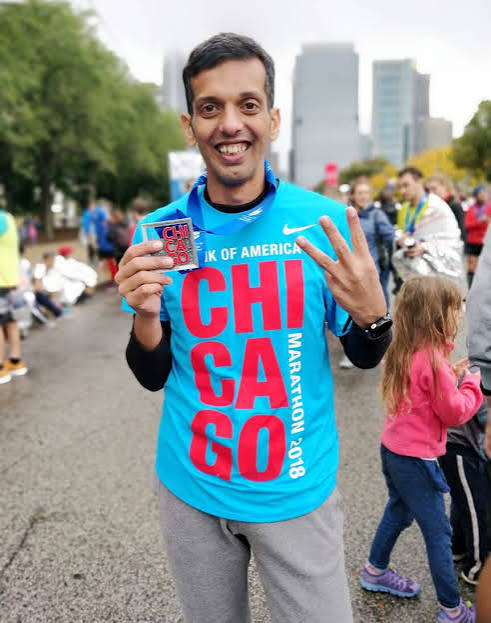 Chicago, 2018 — the running and the company have run on a parallel track for a decade.
The gap he found was a runner's gap, not a strategist's. People at the Mumbai Marathon were importing energy gels or asking friends abroad to carry them back. In 2015 there were, in his words, "hardly options" domestically.
But noticing a gap is the cheap part. "You also had to have skilled people with enough insights into that space to make it happen." The people who gathered around Fast&Up came out of pharmaceuticals — they understood manufacturing, ingredients, R&D and quality systems. And they had access to an effervescent technology the group had acquired from a company in Switzerland around 2011–12.
That combination produced his most quotable strategic claim, and it is worth reading twice:
"India is the hub for the world when it comes to pharmaceuticals. If you can make a name for India in pharmaceuticals, there is no reason why you cannot be the epicentre of nutrition for the entire world."
The launch itself was modest. Three or four products, four or five people managing the brand, and a market that had never seen the format. Early portfolio: a pre-workout product, an effervescent amino-acid tablet called Recover, and energy gels that were already selling in Europe. Reload — the electrolyte product the brand is now known for — had to be developed, and went out in that first wave too.
Then came the part nobody budgets for.
"You realise that it takes time. Because there's a lot of education involved. People are not known to having a tablet."
Picture the actual work. Early mornings at the NCPA end of Marine Drive in Mumbai, handing Reload tablets to runners who did not know what to do with them. "People didn't know how to take this — whether it is a tablet which I have to pop in and drink water with, or whether it had to be mixed with water."
His diagnosis of that hesitation is precise, and it is the difference between a marketing problem and a category problem: "The hesitation was not towards the brand per se, but because of the new format." The fix was not a campaign. It was hours, and days, and repeated presence — after which the earliest converts became key opinion leaders for everyone behind them.
Two structural choices carried that period. The cohort was runners — "more educated, more progressive… well travelled, open to experimentation." The geography was two cities: Mumbai, the commercial hub full of people willing to experiment, and Bangalore, "the fitness capital." The launch happened in Mumbai; the first anniversary in Bangalore. A decade later, "a lot of our revenues still come from these two places."
Then COVID, which he calls a watershed and treats with more nuance than most founders do. It was "a little tricky" — a company built around fitness and sport watching activity stop. Fast&Up was less exposed than its peers for a reason that reads as strategy and was partly luck: they had stayed out of proteins for the first five or six years. Protein-led brands, whose customers were in gyms that shut for seven or eight months, absorbed heavy losses.
What saved the quarter was a product they had carried since year one. Vitamin C — sold as Charge, an orange-flavoured effervescent — became, in his phrase, "the top of the town" as immunity moved to the centre of every conversation.
The aftermath reshaped the category. Awareness rose, brands multiplied, and there was "a lot of confusion" for a year or two before it settled. His summary of where that leaves the Indian buyer is generous to competitors and quietly proud:
"Today you don't need to travel outside and pick up your best nutrition. You already have choices. It's only that the Indian consumer needs to choose intelligently."
Key decisions
Decision 1 — Launch with four products, on purpose
The instinct when entering a market is to cover it. Fast&Up did the opposite, and he treats the constraint as an advantage rather than a compromise.
"It was good that we had only four — because then you can focus on the products, you can educate people much more, rather than getting digressed with ten products, different delivery formats."
The logic is specific to introducing an unfamiliar format. Every additional SKU divides a fixed pool of explanation. With four products, one message — this dissolves in water — could be repeated until it landed. "If you have to live, we have to make that effervescent successful. That is the only thing we cared for at that point of time."
Decision 2 — Choose the cohort before the channel
In 2015 the digital transition was half-finished — "we were caught in the middle" between traditional advertising and digital — and the money to buy reach did not exist, because nobody yet knew whether the thing would work.
So instead of buying audience, they selected one: runners in two cities. Educated, travelled, experimental, geographically concentrated, and — critically — talkative among themselves.
This is the decision that made the sampling model viable. Word of mouth is not a channel you can buy, but it is a channel you can choose to be legible to.
Decision 3 — Gate R&D on manufacturing capability, not market demand
The product funnel starts where you would expect: inputs from athletes, from the market, from what the team sees abroad. "A lot of our inspiration has come from global products. Our goal was: can we provide to the Indian consumer what we see abroad? Why would the Indian consumer be bereft of things which are available outside?"
But there is a hard gate after that, and it is about capability rather than opportunity. If a product only works as a capsule or a compressed tablet, "the chances are going to be less that we would jump into it, because we don't have end-to-end capabilities." Powder, effervescent, and now ready-to-drink formats are in scope, "because we have the baseline technology for that."
Then the pharma discipline: an internal group of scientists, samples, stability testing, protocols, and only then release.
Note what this rules out — profitable products the market is actively asking for, in formats someone else can make better. That is the trade, made explicitly.
Decision 4 — Concede the ACV category and keep the discipline
Apple cider vinegar was traditionally a liquid. A competitor brought it out in effervescent form — Fast&Up's own home format — and built a large business on it.
His account is refreshingly free of spin:
"It should have been our birthright to make it big. But for whatever reason we didn't do it… we are not the number one in ACV effervescent. Because we put our bet on carnitine."
The reasoning was that ACV was a fad that would not stick, and carnitine — in fat-burning and weight management — would compound. Asked directly whether the call cost money, he does not hedge: "Have we missed out on a few crores every month? Yes, we have."
And then the principle that makes the loss survivable:
"At the end of the day, we have to be comfortable with the decisions that we take. Be it business, be it marathon running, or be it life."
Decision 5 — Expand the portfolio after COVID, then deliberately contract it
2020–22 brought a wave of new products, from Fast&Up and everyone else. What followed was less common: they rationalised. "You realise the customers may not have enough appetite for everything. So you cut down, because you need to focus more on business and profitability."
Alongside it, a marketing conclusion drawn from the same period — the perennial performance-versus-brand debate resolved in one direction. "Finally it's the brand pull which matters." Which pushes spend and attention back toward flagship products: "If you are strong in three or four shots, you try to play those shots."
Mental models
Escape velocity
"Somewhere in the middle to late 30s one has an escape velocity where one decides to get out. And once that is done, it is done."
Not a plan — a threshold. Linear corporate progression is tolerable until, quite suddenly, it is not, and the exit becomes irreversible in the mind before it is irreversible on paper.
The useful corollary for anyone waiting for a fully-formed idea: he did not have one. He had a gap he had personally experienced as a customer, and a set of people whose skills matched it.
Go into the battle with what you have
"A lot of times there is a gap. And then you go into the battle with what you have."
Fast&Up did not survey the nutrition market and select the largest opportunity. It had effervescent technology, pharma manufacturing knowledge, and a founder embedded in the running community. The strategy is downstream of the assets.
Apply it: list what you actually possess — a technology, a channel, a community, a manufacturing capability — before you list what the market wants. The intersection is your entry point; everything outside it is someone else's fight.
Brand DNA is accumulated presence
"Over a period of time you come out with a DNA of the brand. When people look at the people behind what you do, day in and day out, how you show up at different events — you form an opinion of the brand. That is when the trust factor comes in."
Trust here is not a message. It is the residue of having been visible, repeatedly, in the places the cohort already gathers. Which is why the early-morning sampling was not a growth hack that got outgrown — it was the brand-building.
The experience-first funnel
"People who taste or experience our product are our biggest well-wishers."
He is equally clear about the ceiling: "You can only sample so many people. You can only sample so many cities." Sampling produces the highest-quality customer and the slowest curve. Looking back at Reload, he thinks it "had the potential to reach millions and millions of people even in the first five years" — a candid admission that the model that built the brand also capped it.
The resolution came from outside: quick commerce. "They are actually solving a lot of our logistical issues. We just need to make sure we send our best products to their distribution centres."
Fortresses and frontiers
"We would have three or four areas which are fortresses for us, which we would not let anyone come into — which you would ring-fence and keep guarding and keep growing."
Beyond the fortresses sit categories where the brand invests to grow, and beyond those, categories it declines even when it could probably win: "We can be good, but let's leave it for the time being."
The decision is taken with the board and management team, and he is unsentimental about accuracy: "The call can be wrong, or wrong time. But once you decide, you go all in."
Leverage runs in both directions
Fast&Up's positioning abroad borrows from India, and its positioning in India borrows from abroad. In the UK — where Reload leads — the Indian diaspora, shared cricket and film culture, and the fact that English cricketers play in the IPL (where Fast&Up supplies the teams) all compound.
"Any asset in India, if I can leverage it outside, is great. Similarly, if I can leverage something outside into India, it is great."
X is never enough
"You feel X is enough, but X is never really enough. You need to have that extra bit."
His answer to founders who arrive with an energy-drink idea copied from something they saw abroad. The resource estimate is always short, the timeline is always long, and the differentiator is willingness to stay past the point where the plan said you would be done.
Frameworks
Framework 1 — The education budget test
For anyone launching an unfamiliar format, not just a new brand.
Before adding a product, ask: how many sentences of explanation does this need before a stranger will try it — and can we say those sentences to everyone we're targeting?
| Situation | Signal | Action |
|---|---|---|
| Format is familiar, brand is new | Competing on trust and price | Breadth is affordable |
| Format is new to the market | Every SKU splits a fixed education budget | Cap the portfolio; over-explain a few |
| Format is new and channels are unbuilt | Reach must be earned in person | Narrow the cohort and the geography too |
Fast&Up was in the third row and behaved accordingly. Most founders in the third row behave as though they are in the first.
Framework 2 — The capability gate
A two-question filter before any product enters development.
- Is there real demand? Inputs from athletes, customers, retail partners, and global markets.
- Can we make it end to end ourselves? If the answer is no, decline — regardless of how good the answer to question one was.
| Can manufacture | Cannot manufacture | |
|---|---|---|
| Strong demand | ✅ Build it — this is the pipeline | ⚠️ Decline, or you become a marketing shell for someone else's factory |
| Weak demand | 🕓 Park it; capability keeps | ❌ Ignore |
The upper-right quadrant is where most brand extensions die: outsourced production, no quality control, and a category where a specialist will eventually outbuild you.
Framework 3 — The two-city beachhead
How to pick where to start when you cannot afford to be everywhere.
- Pick the cohort by openness, not size. Runners were a small market and a receptive one.
- Pick cities by character, not population. Mumbai for commercial willingness to experiment; Bangalore for fitness density.
- Show up physically and repeatedly. Early mornings, sampling, conversations measured in hours.
- Convert the earliest adopters into explainers. They carry the format to the next ring.
- Anchor the calendar to the beachhead. Launch in one city, anniversary in the other.
The test of a beachhead is not whether it grows — it is whether it still pays a decade later. For Fast&Up, both cities still do.
Framework 4 — Comfortable decisions, not correct outcomes
A way to hold conviction without pretending to certainty.
Separate the two questions you are tempted to merge:
- Was the outcome good? Sometimes not. ACV cost them crores a month.
- Would we take the same decision again with the same information and the same values? Yes.
A company that only optimises the first question follows every category the market rewards and eventually stands for nothing. A company that can answer the second question keeps a coherent identity through the misses — and identity is what he means by brand pull.
Lessons
Building and brand
- Strategy is downstream of assets — start from what you can actually do, not from where the market is largest.
- In a new format, portfolio breadth is a tax on comprehension. Launch narrow.
- Education is the most underestimated cost of a category-creating product.
- Resistance to something new is usually about the format, not about you. Diagnose which before spending on a fix.
- Choose a cohort that is open, concentrated and talkative — receptivity beats size at the start.
- Physical presence compounds into brand DNA in a way advertising cannot buy early on.
- Sampling produces the best customers and the slowest curve; know that you are trading speed for trust, and plan the channel that lifts the ceiling later.
- Gate the pipeline on manufacturing capability, not on demand alone.
- Expansion should be followed by deliberate rationalisation — customers do not have appetite for everything you can make.
- Brand pull, not performance marketing, is what remains when the spend stops.
- Leverage assets in both directions across markets; diaspora, sport and culture are real bridges.
- Losing a category you should have owned is survivable if the decision was principled; drifting between categories is not.
Career and leadership
- You do not need to have wanted to be a founder at 22. Forty is a legitimate starting line.
- Escape velocity is real: when the pull to leave arrives, it does not reverse.
- A parallel discipline — for him, distance running — is not a distraction from the company; it can be the source of the temperament that runs it.
- Hire for intention and integrity ahead of credentials; educational background is not the only criterion.
- Give the people you work with freedom and let them evolve — a founding team of four cannot supervise 300.
- The strongest cultural signal is voluntary: people showing up at weekend events that are in nobody's KRA, because "they instinctively feel the brand is their own."
- Be comfortable with your decisions rather than certain of your outcomes — in business, in racing, in life.
- Whatever you have budgeted — money, time, patience — X is never really enough.
Actionable advice
This week
- Write down the three assets you actually hold — a technology, a channel, a community, a manufacturing capability. Then check whether your current roadmap is built on them or on someone else's.
- Count the SKUs or features you are asking a first-time customer to understand. If the number is above three, you are probably rationing your own explanation.
This month
- Define your beachhead precisely: one cohort, two cities (or two segments). Openness first, size second.
- Run the capability gate over everything in development. Anything you cannot build end to end — decide consciously whether to decline it or accept that you are renting someone else's quality control.
- Name your fortresses. Three or four categories you will ring-fence and defend. Everything else is either a frontier you are funding or a pass you are declining.
This quarter
- Spend real hours in front of your customers where they already gather — early mornings, events, whatever the equivalent of Marine Drive at 6 a.m. is in your market. Not a campaign; presence.
- Audit the last two years of launches and rationalise. What did you add because the market briefly rewarded it, and does it still earn its place?
- Take one category you have been half-entering and either go all in or say no in writing, with the reasoning recorded so you can judge the decision later on its own terms.
Final thoughts
The temptation with a story like this is to read it as timing — the right format, the right decade, a category that was about to explode anyway. He does not allow that reading.
Asked whether a 20-year-old could start a nutrition company today, his answer is not encouragement and not discouragement. It is a warning about duration:
"Even though nutrition seems easy, when you get into it there are a lot of nitty-gritties, and you have to stay the course. That is the reason why you will not have a lot of companies who have been in this game for a longer period of time. You'll have a lot of companies coming in and getting out."
The bottleneck, in his view, is not regulation or manufacturing — "if you are able to make a product in India, you will be able to work globally; it may take a year, but you'll find people who can help." It is the opening move in India, where brand-building is now expensive, distribution is crowded, products look alike, and marketing takes the larger share of everything you raise.
Which brings the whole conversation back to where it started. A man who runs marathons built a company the way he runs: not by finding a shortcut, but by staying in the thing long after the interesting part is over. Four products until the format was understood. Two cities until they paid. One category declined on principle while a competitor made money from it. Ten years of showing up at events that nobody was required to attend.
His stated ambition for the next five years is national in scope — a bigger global footprint, more territories, and to "be remembered as one of the best ever nutrition companies to have come out of India." Given how the first decade was built, the interesting question is not whether that happens quickly. It is whether they stay in it long enough that it does.
"You feel X is enough, but X is never really enough. You need to have that extra bit."
 Vijayaraghavan Venugopal — CEO and co-founder of Fast&Up.
Vijayaraghavan Venugopal is the CEO and co-founder of Fast&Up, an Indian nutrition brand founded in 2015 and now sold in roughly 25–30 countries, with around 300 people including manufacturing. He is a distance runner with ten-plus sub-three-hour marathons to his name.