From marketer to CEO
Three decades, a long stint at Coffee Day, and several ventures of his own. His most contrarian advice to founders — stop selling to the customers who only want the discount, and watch revenue rise.
Watch the full episode on YouTube
Executive summary
Our guest has spent three decades moving between large Indian corporates and startups — most notably close to a decade at Coffee Day — and now advises founders while running ventures of his own across health and wellness, branding and hospitality.
He came up through sales and marketing and ended up in CXO and CEO roles, which produced the realisation the whole conversation circles back to.
First: the job you get promoted into is not the job you trained for.
"In B school, I didn't spend much time in finance and HR, because I'm a marketing guy — and marketing guys think marketing is everything. I realised the more I went up the ladder, HR and finance became more important."
His summary of what a CEO actually does is two clauses long and hard to improve on: "you spend most of your time managing people and managing money." One eye on the money, the other on the people. Marketing became perhaps 10 to 20% of his week; the rest is supply chain, HR, performance and operations.
Second: the product is the easy part.
"Developing a product, if you ask me, is the easiest thing to do... I think the challenge is the go-to-market. And before that, you need to decide what your target audience is going to be."
He is blunt that this is where most of the founders he consults for are weakest: "in many cases, they don't have a clear definition of the target audience." And he relays the same verdict from investor friends — "the GTM is not good. That is where the crux is."
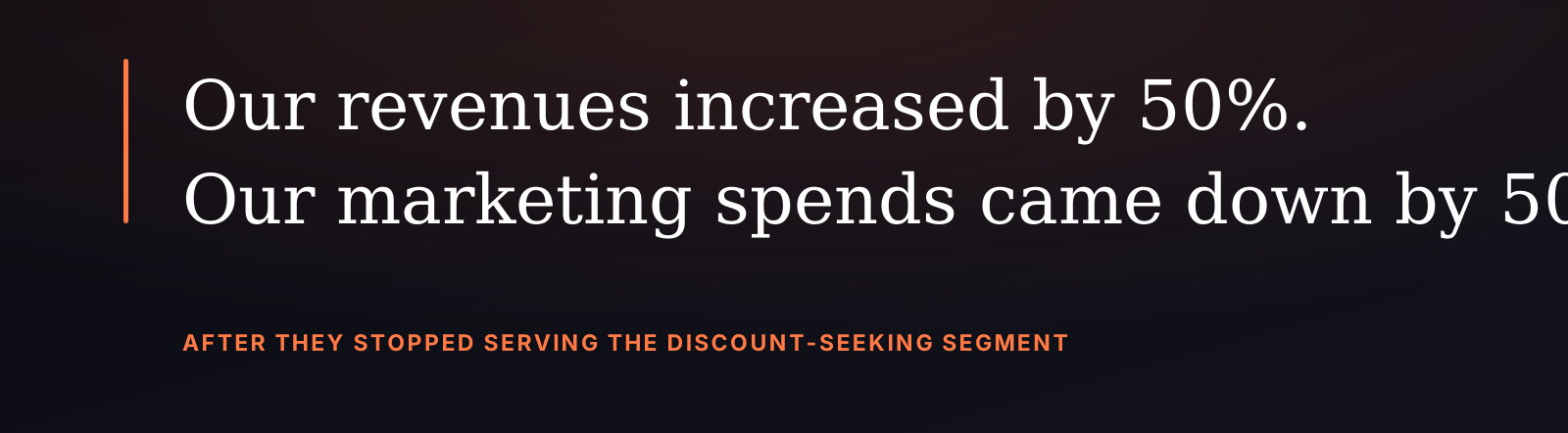
Third, and the finding that pays for the whole episode: on a consulting engagement, the data showed two distinct customer sets — one that cared about quality and would pay a little more, and one that only ever wanted the discount. They stopped serving the second group entirely.
"Our revenues increased by 50%. Our marketing spends came down by 50%."
The story
He describes his career as moving "some out of choice, some out of necessity" — boredom, the occasional cultural mismatch, and mostly the pull of a bigger challenge. What it produced was breadth: he expected to work only in consumer, then discovered he wanted B2B; he expected a career in marketing, then found himself running companies.
He is also quietly proud of a choice most people would not advertise: "I largely worked in Indian companies and not multinationals."
Coffee Day was the formative stretch. He joined hoping to raise funding for a venture of his own, and the chairman redirected him: "forget all that, boss — join me, we'll do something together."
What he got there was something close to entrepreneurship inside a company. The instruction was to "treat it like your own business" — not as a slogan but as genuine delegation of responsibility and authority, extended to most people in the organisation, and coupled with real cost discipline.
The other thing that stuck was a culture of listening that started at the top:
"He himself used to visit cafés every week. If the boss does it, you better do it. So from the top till the bottom, everybody used to meet customers."
And his verdict on what the brand became, which he offers carefully as someone who has been gone from the company for years:
"Cafe Coffee Day was an emotion. You'll nurse one cup of coffee for three hours. Couples proposed to each other in a cafe. People have started businesses in cafes."
Key decisions
Decision 1 — Learn the function rather than hire around it
Asked for a process to make cross-functional work succeed, he rejects the premise:
"I look at attitude. There is no process... You cannot teach attitude. You can teach skill, but you cannot teach attitude."
He applies it to himself first. Early on, he never needed to know financial ratios. Going up the ladder, he did — "and I can't say I would not learn." So he learned to read a balance sheet properly, in bite sizes.
The rule he derives is a good test for any leader eyeing a gap in their own knowledge:
"You bring in somebody else only when you feel the value that person brings is better than what you can provide. Otherwise, you have to just learn."
Decision 2 — Take the call at eleven at night
His answer to what a startup team structure looks like is really an answer about ego.
Running his own restaurants, he cleaned tables, worked the cash counter and served food. Setting up resorts at Coffee Day, he was the person taking booking calls at 11pm and midnight. Running an airline catering business, calls came at 2am and 4am.
"That's the business. It's a 24-hour business, and I've taken the responsibility. I can't say that after this, I cannot take the calls."
And the principle underneath: "you should not say this role is too low for me."
Decision 3 — Fire the discount-seeking segment
The consulting story is the most quantified decision in the episode, and the most counter-intuitive.
Analysing the customer data, they found a core group who cared about quality of service and were "not too bothered about paying a little extra", and a separate group who only ever transacted on discount. Three cohorts emerged once they built proper personas.
The decision was to stop chasing the price-driven set and serve only the value-driven one. Revenue rose by half; marketing spend halved.
His generalisation is the part to take away, and it works as a diagnostic:
"If you feel that if I don't offer discounts, I'll not have anybody to buy my product — either something is wrong with the product, or you selected the wrong audience."
He applies the same lens to founders whose sampling campaigns fail to convert: "so obviously you got your audience wrong."
Mental models
The mongrel principle
His own name for it, and the most memorable idea in the conversation. He keeps both pedigree and non-pedigree dogs, and has noticed something:
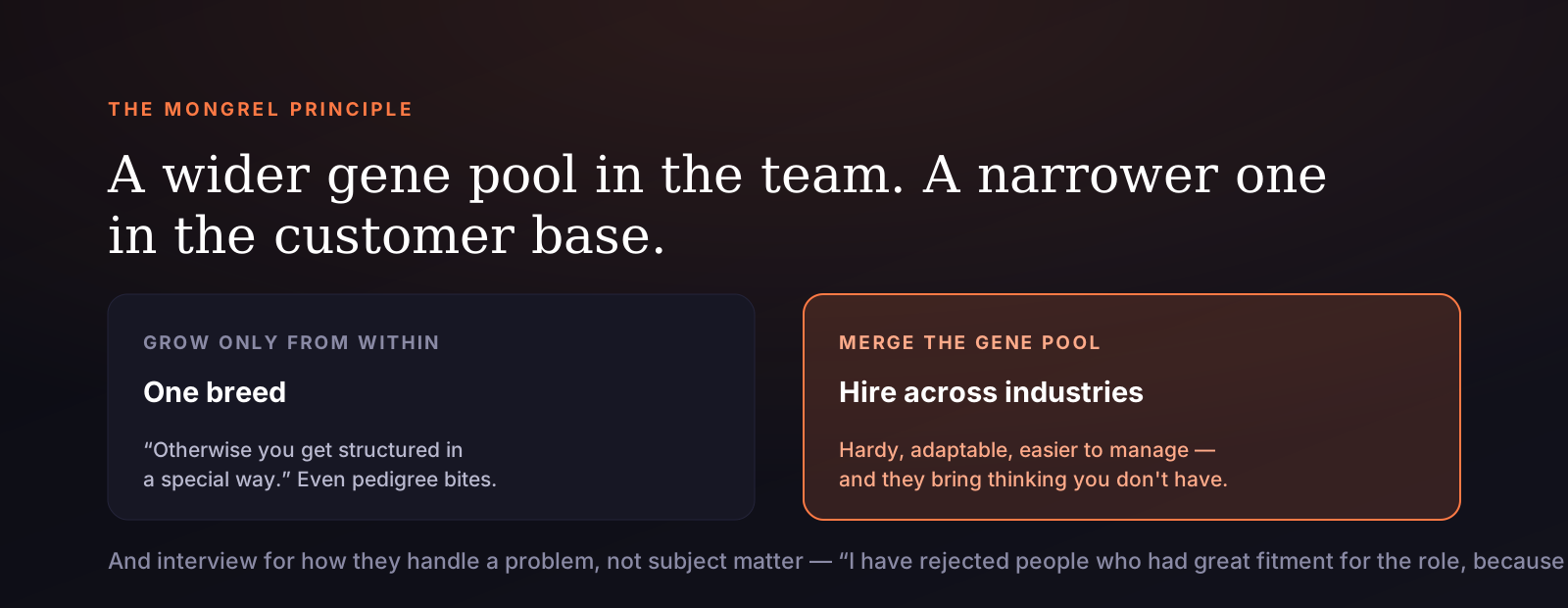
"Even pedigree dogs bite. Non-pedigree dogs are hardy, they adapt fast, they are far easier to manage... Why are these Indies, as we call them, stronger? Because there's a gene pool from everywhere merged."
Applied to organisations: hire across industries, widen the gene pool, and resist the instinct to grow everyone from within.
"At times you need to get people fresh from outside to have fresh thinking. Otherwise you get structured in a special way."
Which in practice means giving experts a free hand and staying open-minded about the role, rather than briefing a recruiter with "I will only take people from this sector."
Hire for how they handle a problem
"My questions when I ask people are largely more on the way they will handle a problem, rather than subject matter. Subject matter will be handled by HR and my teammates. I really look for the attitude."
And he has acted on it at cost: "I have rejected people who had great fitment for the role, because of the attitude."
He is also candid that this is the hardest problem in the market right now: "lots of people, but hiring the right people is the biggest challenge."
Frameworks are guides, not rules
"Frameworks are there for you to guide you. You may change that framework to suit your business requirement... there's no one solution which fits all."
He has used BCG and others, and mixed them freely depending on the business.
Discounting is a trial mechanism with a built-in filter
Why discount at all in the early days? To get people to try. "If my product is good enough, they will buy it, even at a higher price."
Then as prices normalise, a natural filter operates. Some customers drop away — they were only ever buying the price. The ones who remain are the core. "The hope is that that core set of customers will be large enough to sustain your business."
Frameworks
Framework 1 — Audience before brand, always
His ordering for anyone building something new: understand the product, understand the audience deeply, establish product-market fit, then build the go-to-market — under which he files brand, sales and marketing together.
The name, which founders agonise over, he waves away: "developing a name is the least of my worries."
The soap example makes the point concrete. The same category splits into completely different businesses depending on who you are for:
"A soap can be a super premium soap, or a janta mass soap — my audiences are completely different. I can't market a super premium soap to the masses; they will not buy a soap for 150 or 200 rupees."
And the reverse holds too. Premium buyers will not switch down, because they believe the better soap is better for their skin, and they can afford the difference.
Framework 2 — Go-to-market is shaped by the business, not by a template
Two illustrations from opposite ends:
A semiconductor company goes to two or three OEMs or ODMs and asks whether they will build products around the chip. "What will a B2C customer do with a semiconductor chip?"
A premium soap goes online — marketplaces like Amazon, Flipkart and BigBasket, quick commerce like Zepto and Blinkit, plus the beauty platforms.
"The fundamentals of business don't change. The tactical measures will change."
Framework 3 — Pricing has no default direction
Two consulting stories with opposite answers, which is exactly the point.
Price it up. A career-progression product was priced in double digits. He told the founder to make it three. "The higher we price it, people think it's more premium... Don't discount your product too much. Let few people buy it at a higher price and see the value it offers. They will recommend it to other people."
Price it down. An entrepreneur planning a coffee kiosk wanted to charge ₹150 for a cappuccino, positioned against Starbucks and Third Wave at ₹300. His advice was to go under ₹100 — "the lower the better."
The reasoning is about what the customer is actually buying:
"When you're sitting in a Third Wave or a Starbucks or a Coffee Day, there are a lot of other things — you're sitting in a comfortable place, there are a lot of other things which add to the experience. In a small kiosk, you may have a couple of tables. How many people will pay 150 rupees for a latte?"
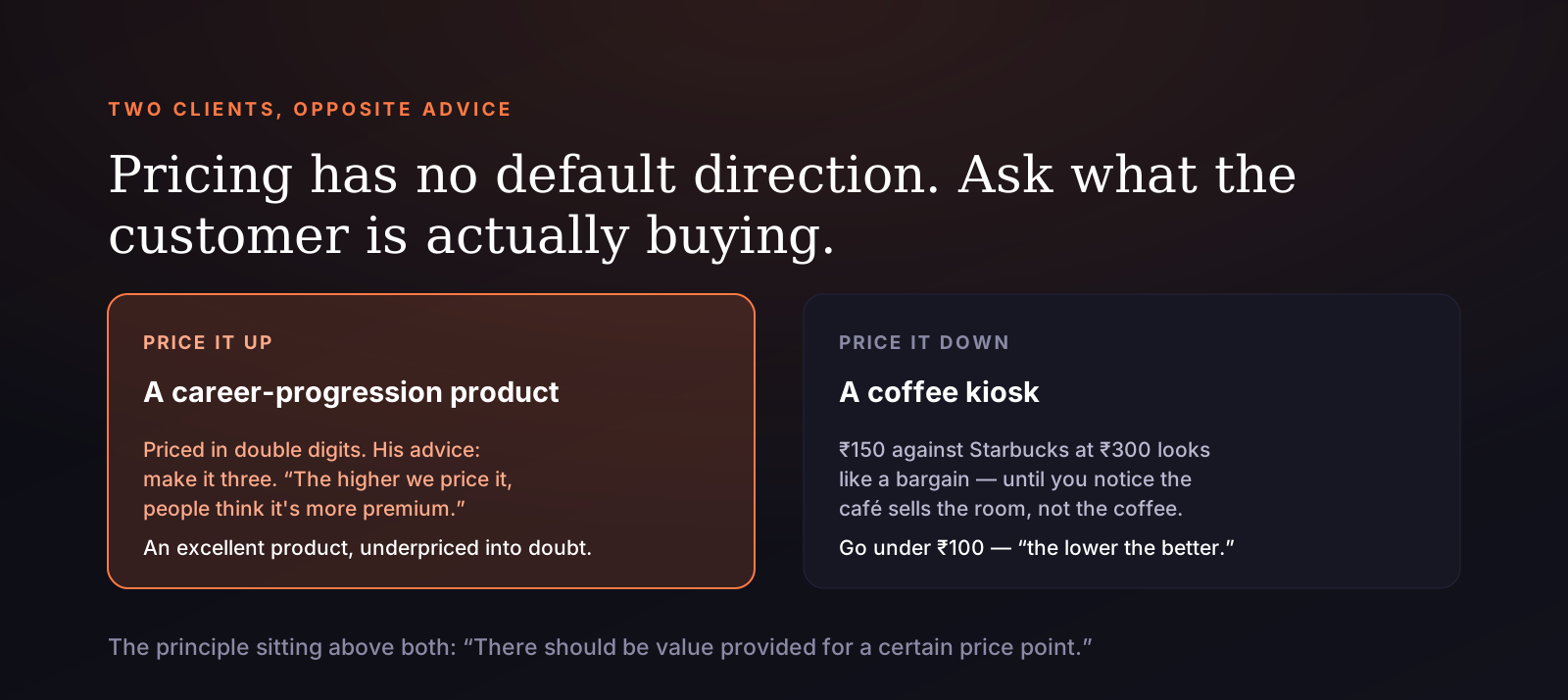
The governing principle sits above both: "there should be value provided for a certain price point."
Framework 4 — Research, qualitative first
Secondary data is abundant and he uses it. But his real preference is talking to people:
"I really enjoy qualitative research, because there are so many nuggets of wisdom you get out of there. It's unbelievable."
His method is often to run a focus group, extract the surprising points, and then quantify those specifically.
The story he tells is from his early Coffee Day years, researching how people relate to filter coffee. He visited four or five households in Chennai and Bangalore and found something no dataset would have surfaced:
"Each household, especially in the Tamilian household, each person thought that their coffee was the best. And very frankly, all their coffees were good."
Each had their own blend, described with real pride. The strategic consequence is the interesting bit — not how to convert them, but whether to try at all: "How do you navigate through that? Are they even a part of your audience? Maybe you need to look at another thing."
Lessons
New Coke is his warning about over-trusting research. Blind tests showed Pepsi's taste was preferred. Coke reformulated accordingly, and it failed — "because people equated Coke not just to taste alone, but all those parameters, all those values of what the brand offered." Classic Coke returned, New Coke was phased out. "After so much research, it bombed."
Crowded categories are not closed categories. "Did you think another entrant could come into transportation after Uber and Ola? No — until Rapido came and changed the business model." He notes a competing CEO went on record naming Rapido, not the obvious incumbent, as the real competition. The detergent market tells the same story across decades: Nirma disrupted it, Wheel disrupted Nirma, Ghadi disrupted again across Central India and UP.
"In an ideal scenario we'd like to address a virgin market. But it's not [realistic]... I don't think you should be restricted in your thinking. The way you tackle a problem is more important."
Risk does not concentrate at one stage. "There's a risk element involved in every aspect of your business." Taking a product that works in India to Europe is "practically setting shop and starting all over again, because the market is new."
On AI, he is unromantic: "AI is a tool. End of the day, the thinking has to come from the people. AI will tell you this is the information for this particular thing. Now you take a call on what you have to do."
Culture fit is a real reason to walk away. He has declined assignments and left companies over it. "Sometimes you join a company and — oh God, this is a total cultural mismatch." Especially in a startup, where "everyone is doing everything" and there is nowhere to hide from a bad fit.
On being an advisor versus an operator: "You go to an advisor when you feel that advisor can add more value than what you and your team can give." The hats differ — an operator is hands-on and directing; an advisor gives direction and then "the team will take the ball and run with it."
Actionable advice
If you are moving up into a general management role: start learning finance and HR now. They will occupy more of your time than the discipline you came from.
If your product only sells on discount: treat it as a diagnosis rather than a pricing problem. Either the product is wrong or the audience is.
If you cannot define your personas in a sentence: stop working on the brand and go do that first. Everything downstream depends on it.
If you are hiring: interview for how they approach a problem, widen the gene pool across industries, and be willing to reject an excellent CV over attitude.
If you are setting a price: ask what the customer is really buying. A premium product can be underpriced into invisibility; a kiosk latte cannot borrow a café's atmosphere.
If you are doing research: talk to people first, then quantify the surprises. And remember that a blind taste test can be perfectly executed and still tell you the wrong thing.
If you are entering a crowded category: the entrants who succeed usually changed the model rather than the product.
Final thoughts
The 50/50 result — revenue up half, marketing spend down half — is the number people will remember, and it deserves the attention, because the decision behind it is one almost nobody makes voluntarily.
Every instinct in a growing business says to serve more customers. The discount-seeking segment is real, it shows up in the numbers, and cutting it off means watching a chunk of your addressable market walk away on purpose. What his team found is that those customers were consuming marketing spend without ever converting into anything durable, and that the quality-led customers had been subsidising them the whole time.
That is the same argument as the mongrel principle, and as the advice about audience preceding brand: precision about who is worth more than reach across everyone. A wider gene pool in your team, a narrower one in your customer base.
It also explains why he thinks the product is the easy part. Building the thing is a problem with a specification. Working out who it is for — and having the discipline to say no to everybody else — is a problem with no specification at all, and it is the one that decides whether any of the rest matters.