From startup to a $200M deal
Ankit Mehrotra passed his CFA Level 3 and resigned the same day. Twelve years later he sold Dineout to Swiggy — then walked away from the ecosystem to start again, because founders make bad employees.
Watch the full episode on YouTube
Executive summary
Ankit Mehrotra co-founded Dineout, grew it to roughly 50,000 restaurants across 42 cities and 75–80 million diners a year, sold it to Swiggy, spent two years inside that ecosystem, and then left to build The Medical Travel Company — a platform moving patients from the UK to India for elective surgery.
The episode covers a full arc: investment banking in London, the 2008 crash, a decade building a consumer product in India, an acquisition, and the decision to start over. Three ideas hold it together.
First: the 2008 crisis did not cost him his job. It cost him his belief in jobs. Watching friends at Lehman turn up to find the bank gone, working 14 to 16 hour days because someone with three times his experience would now take his salary or less, he arrived at the arithmetic that started everything:
"If I'm going to be working 14, 16 hour days, do I want to be working for someone else, or actually building impact for me? Because the point is that there is no stability. One night or one event can spoil your career of the last 15, 20 years."
Second: execution is the entire game, and execution starts with a date. "Ideas are a dime a dozen. It's all about how you execute them." Dineout spent two or three months going in circles until they picked a hard launch date — 29 February 2012 — and worked backwards from it. They went live with 75 restaurants in South Delhi.
Third, and the most commercially interesting part: they took a position on honesty and it became the growth engine. Every competitor advertised big percentages with a cap buried in an asterisk. Dineout's discounts were uncapped.
"That is actually misleading marketing the consumer. If we say 20%, it has to be 20%. If we say 40%, it has to be 40%."
The story
He was supposed to be an engineer. He studied for the IIT entrance, did not get through, and negotiated a deal with his parents that tells you most of what you need to know about him:
"I'll complete my engineering degree. But that is the last time I have anything to do with engineering."
He kept both halves. He finished computers and telecom engineering at the University of Essex, and on the day he graduated he was done with it. What he actually wanted was finance — so he spent a year in London bartending and waiting tables while teaching himself the subject from scratch.
Then he applied to nearly 200 companies. BNP Paribas took him onto a graduate training programme with four or five places a year, competing against Cambridge, Oxford and LSE with a bachelor's from Essex, and needing visa sponsorship on top. Over five and a half years he rotated through investment banking, forex trading and wealth management, and earned a CFA charter from a non-finance background.
Two things about London reshaped him, and neither was technical. The first was simply seeing other lives: "there is life just beyond being an engineer" — friends pursuing music, art, sport. The second was more structural:
"That actual environment removed the fear of failure."
Then 2008. "Overnight banks were collapsing. I had a lot of friends at Lehman Brothers where the next day they turned up and the bank doesn't exist."
The idea itself arrived at work. In November 2010, on a BNP Paribas deal where OpenTable was acquiring the UK's TopTable, he looked closely at the model and realised nothing like it existed in India. He had also watched dining in London shift from occasion-led to experience-led, and believed the same wave was coming.
The personal evidence was sharper than the market research. Visiting India three or four times a year, he noticed he always went to the same three or four restaurants — new ones opened weekly, but nobody would risk them. "You don't want to have a bad experience, you don't know the food, you're spending a lot of money."
He called Sahil, a childhood friend from nursery, then in Seattle after an MBA. A month later Sahil called back: great model, I love it, I've quit my job, I'm moving back to India.
Then 11 August 2011 — he passed CFA Level 3, and resigned the same day.
Four founders, all 26, all friends since nursery: Ankit, Sahil, Vivek (ten years in the merchant navy) and Nikhil. Four sets of parents, also friends, concluded the boys had gone mad, and settled on one demand: "we don't care what you do, we have to get you married." Three of the four married within a year.
This was 2011, before entrepreneurship was a CV asset. "You guys are all well settled, having great corporate jobs, and you want to quit? Who the hell do you think you are? You are not from a business background."
They funded it from savings. "Words like bootstrap is what you hear now. But at that point, we didn't know any of these concepts."
Key decisions
Decision 1 — Set the date, then work backwards
For two or three months they went in circles, pitching restaurateurs who had run their businesses for twenty or thirty years and saw no reason to change: "why the hell do I need some online platform?"
So they picked a date and committed to it publicly among themselves.
"29th February 2012 is when we decided we are going to make the platform live, whatever happens — whether we have five restaurants or 50, it doesn't matter."
They launched with 75, in South Delhi. His framing of why this works generalises well beyond startups: "the first step is always the hardest. That's when we procrastinate, that's when we have a lot of doubts. But as soon as you take it, you know that now I'm on this journey, I'll figure out a way to make it work."
Decision 2 — Pivot on day two
They had built exactly what Sahil used in the US and Ankit used in London: a pure online reservation platform. It went live on 29 February. It lasted one day.
"On 1st March we realised that, oh my God, pure online is not going to work in India."
Internet penetration was still climbing. Just Dial was enormous; Indians looked things up by calling. So on day two they went out for phone lines and stood up a call centre — which stayed in place from 2012 until COVID.
The lesson he draws is about speed of correction rather than quality of planning: twenty conversations were enough to overturn the founding assumption, and they acted on it immediately.
Decision 3 — Keep the discounts uncapped
Dineout stacked three layers of discount: the restaurant's own, a banking partner's, and Dineout's. The HDFC Infinia partnership he calls legendary — a flat 15% off up to ₹1,000 on every meal. Together, consumers routinely saved 30–40%.
But the differentiator was the refusal to cap. Competitors across food delivery, travel and hotels advertised 40 or 50% with a ceiling of ₹100 or ₹200 hidden in the terms.
Uncapped meant someone throwing a party on a ₹1–1.5 lakh bill actually saved ₹15,000 to ₹30,000. And Dineout surfaced it — the app showed users their cumulative savings for the year, and people shared totals of ₹50,000 to ₹1.5 lakh.
He is unsentimental about why it worked: "Let's call a spade a spade — Indians love a discount." And the psychology is social rather than economic. A restaurant discount is "a chip on your shoulder or showing off. I go normally and I get 20% discount, you don't."
Decision 4 — Leave after the acquisition
The exit was never the plan. "Our objective with Dineout was to make it really big and to continue growing." But COVID had twice taken the business to zero, growth needed funding, Zomato had IPO'd, and the metrics were excellent. Several of India's largest consumer internet companies came calling. They chose Swiggy on the basis of the founders' vision and alignment with the leadership team.
He is honest about how it felt:
"It's a proud moment, because it obviously means that you built something of value. But also it's a bittersweet moment... you're giving away something which you built with a lot of hard work, tear and sweat."
And the sharper image: "imagine growing up your child, and after 12 years you're giving that up and leaving it completely in someone's hands."
Two years inside the ecosystem produced the second decision. "We realised that we don't want to be actually employees — we are founders." So they left Swiggy, left Dineout behind, and started from nothing.
Mental models
Crises manufacture companies
His read on why downturns matter, and why he expects the pattern to repeat:
"If you look at the history of the world for the last 120, 150 years, all great companies have been formed just after periods of great economic and financial crisis."
Dot-com bust into Amazon and Google. 2008–09 into the next cohort. COVID into the one after. The mechanism is psychological: "periods of great financial and economic stress force people out of the comfort box" — they introspect, question their choices, and come out with something new. He also thinks it gets easier each cycle, because the tooling improves — no real internet in 2000, no social media in 2008, and now AI.
Growth arrives in steps, not slopes
Dineout's trajectory was a series of unlocks, each roughly an order of magnitude:
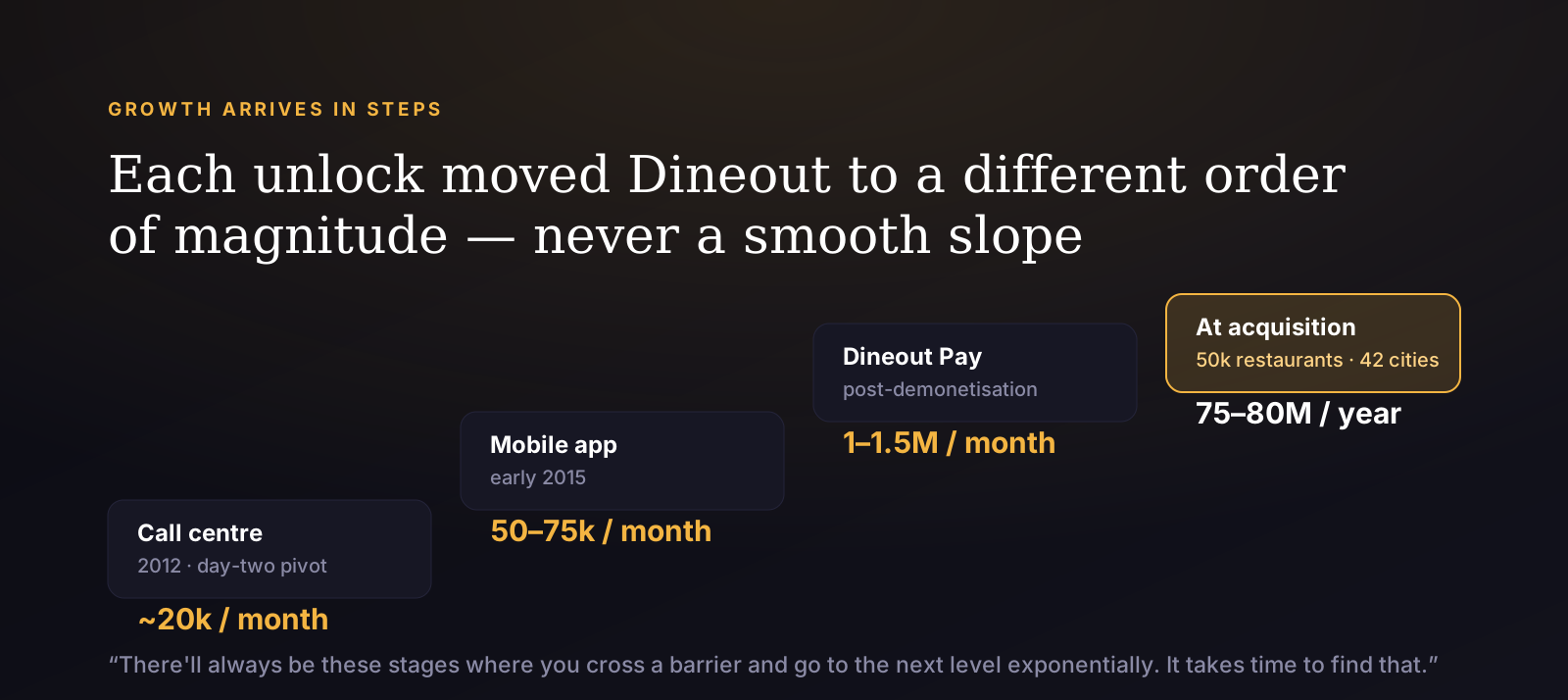
"There'll always be these stages where you actually cross a barrier and go towards the next level of growth exponentially. It takes time to find that."
Consumer positioning beats ecosystem positioning
Asked whether founders should map where their product sits in an industry ecosystem from day one, he pushes back:
"It's very difficult on day one to actually have that mindset, because businesses evolve and pivot very quickly... It's important to understand what you represent for the consumer, and why will a consumer use you, and why will they keep using you again and again."
The ecosystem position is an outcome, not an input. "If you're around long enough, you automatically are able to carve a position for yourself in the larger ecosystem."
Build fast beats build right
His answer in the rapid-fire round, and he means it literally:
"Build fast, because the faster you build, the faster you learn, the faster you iterate. Build right is a unicorn — it is one of those mythical things that doesn't exist, because you will always keep pivoting."
Frameworks
Framework 1 — Reading the signal that something is wrong
Asked for the first sign a startup is not working, he redirects from feedback to behaviour:
"Consumer feedback sometimes is not that someone will come and tell you directly, but the fact that someone has used a product and is not using it again."
The word he settles on is deliberate: not consumer feedback but consumer insight — understanding how and why people interact with the product, including the ones who quietly stopped.
Framework 2 — Hiring, the most expensive lesson
"The one thing that I learned in the hardest and most expensive way is hiring. One bad hire can spoil a great team."
And the single trait he screens for in the first ten people:
"Can they show me that they have perseverance? A startup journey is a marathon, not a sprint. A lot of things will change, go wrong. You need to make sure the person you bring on board is in it for the long haul."
Framework 3 — The COVID playbook
Restaurants closed globally for the first time in recorded history — "even in times of crisis, world wars, restaurants were always a melting pot." A thousand-person team, burning cash, went to zero revenue.
What they did: cut a third of the team, took company-wide pay cuts, and then spent the shutdown making the business structurally better rather than waiting it out.
"We made the product better. We cut out a lot of burn... so that once we come out of COVID, we will be becoming profitable a lot faster."
The result was the part nobody predicted. Revenge consumption took them to 3× pre-COVID within six months of reopening. Wave two knocked them back to 20%. By December 2021 they were at 6× pre-COVID. Dining frequency per user went from 4 to 7. Average ticket rose from ₹2,200 to ₹3,500.
Framework 4 — The medical travel thesis
After Swiggy, they screened categories and rejected two: EdTech was "done to death", and in FinTech "there were already thousands of players and we had no right to win." Healthcare was the one with room.
The thesis rests on an asymmetry that opened after COVID:
The developed world is under strain. The NHS has roughly 8 million people on waiting lists, COVID compounded by Brexit. US insurance premiums and co-pays have climbed sharply. Canada has no private insurance. Australia has waitlists.
India improved at the same time. Unprecedented private equity investment in healthcare infrastructure over five years, plus a reverse brain drain — doctors who left in the 1980s and 90s returning in their fifties and sixties, bringing global best practice with them.
"If India is doing so well, and if the world is struggling, why are people not coming to India?"
Medical tourism is already a $100 billion industry, and India ranks tenth at about $10 billion — but 99% of it comes from Africa, the Middle East, CIS countries and Bangladesh. Less than 1% from developed economies.
His framing of the opportunity is the sharpest line in the second half:
"2000 to 2010 was the era of call centre outsourcing, and India was front and centre. 2010 to 2020 was the era of tech outsourcing, and India was again front and centre. We believe the next decade is all about healthcare outsourcing."
Framework 5 — Designing for trust instead of price
The existing market is "unorganised, broken, agent-led" and fragmented on both ends. Their inversion starts by relocating the beginning of the journey.
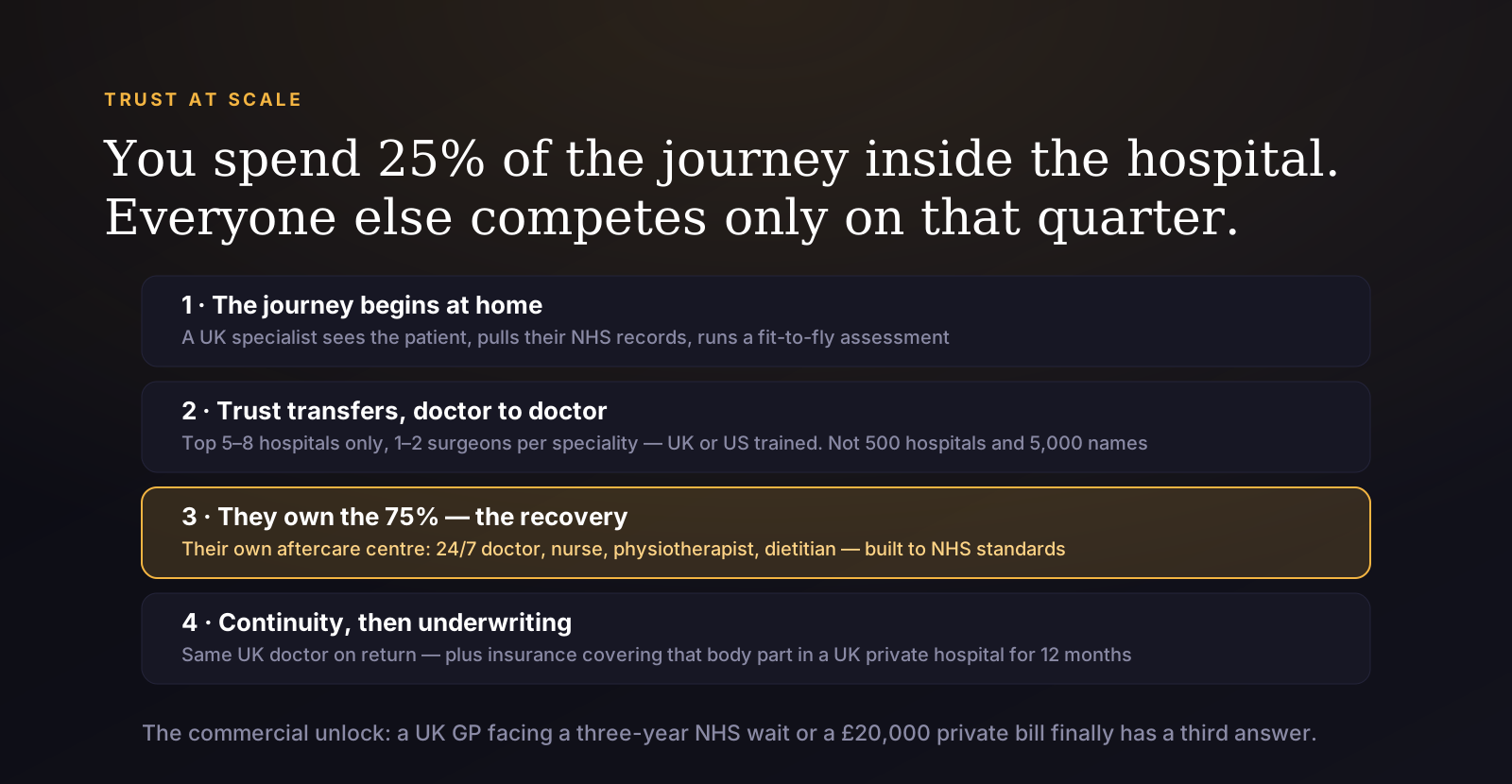
It begins at home. A UK specialist sees the patient in the UK, pulls their NHS records, and performs a fit-to-fly assessment. That doctor then introduces the Indian surgeon — so the trust transfers through someone the patient already trusts.
Radical narrowness. Where competitors list 500 hospitals and 5,000 doctors, they work with the top five to eight hospitals and one or two doctors per speciality per hospital — all UK or US trained, most with NHS experience.
They own the recovery. This is the insight the rest of the industry misses:
"You only spend 20 to 25% of your time inside the hospital. You spend 75% of your time outside the hospital recovering."
That recovery normally happens in guest houses and hotels with none of the right food, medicine or physiotherapy. So they built their own aftercare centre — 24/7 attendant, six meals a day, in-house dietitian, nurse, doctor and physiotherapist, built to UK NHS standards under their own UK board.
And they underwrite it. The piece that took longest to launch: an insurance product covering the body part operated on in India, treated back in the UK at a private hospital, for 12 months after surgery.
"Essentially what we are telling the patients is — if you come with us, we believe in Indian healthcare so much that we are willing to underwrite the surgery."
The commercial unlock is what it does for the referring doctor. A 65-year-old needs a knee replacement: three years on the NHS, or £20,000 privately. "The doctor has no answer. We have now become that third viable answer" — three weeks instead of three years, at roughly half the private cost.
Lessons
Underestimating the difficulty was load-bearing. "We were foolish at that point in time to underestimate the challenges of what it will take to build." They were 26, had one thought — this is what we want to do — and assumed they would figure out the rest.
Distribution channels for a trust business are physical. TMTC runs on-ground events, direct patient interaction, and relationships with UK private GP practices, with B2B partnerships developing. "It's a people first, interaction first, trust first business."
What success now means to him: "Building legacy. Success would be if I've been able to build a company that outlasts me and is here for the next hundred years."
The book he recommends is Finding My Virginity by Richard Branson — chosen precisely because it is not an internet-era story. "Richard Branson built in the eighties and nineties, where the internet didn't exist. It was done on ground with a lot of hard work, grind, grit." He picked it up on the strength of the title alone, not realising whose it was.
Actionable advice
If you are stuck before launch: pick a date and work backwards. Ship with five customers if that is what the date gives you.
If your first assumption breaks: correct in days, not quarters. Twenty conversations were enough to redesign Dineout's entire channel strategy.
If you are competing on a promotional offer: consider making it honest and uncapped. It is a harder unit economic and a much better story, and it gave them social proof they could not have bought.
If you are hiring your first ten: screen for perseverance, and treat a bad hire as the most expensive mistake available to you.
If you are choosing a category: look for an asymmetry that has recently opened — one side deteriorating, the other improving — rather than a market that is simply large.
If you have just sold your company: notice how the next two years feel. Being a good founder and being a good employee are different jobs.
Final thoughts
The uncapped discount is the detail worth carrying away, because it is the whole company in miniature. Every competitor had worked out that a capped percentage looks identical to an uncapped one in an advertisement and costs a fraction as much. That is a perfectly rational choice, and Dineout declined it.
What they got in return was a number users voluntarily showed their friends. You cannot buy that with performance marketing, and you cannot manufacture it later — it only exists if the promise was real the whole time.
The same instinct shows up in the new company, transposed to a market where the stakes are considerably higher than dinner. Everyone else in medical tourism competes on price and volume: more hospitals, more doctors, lower quotes. TMTC narrowed to five hospitals, kept the patient's own doctor in the loop from beginning to end, built the recovery facility themselves, and then insured the outcome in the patient's home country.
That is an expensive way to compete. It is also the only way to sell surgery abroad to someone who is frightened — which is the actual product. As he puts it, the thing being built is trust at scale, and the discount was never really about the money either.