Winning sales & strategy in enterprise SaaS
Kumar has sold for HCL, Tally, Pine Labs and now SatSure — satellites for a country that had no commercial space industry a decade ago. His test for a good salesperson is whether they will tell you the jeans don't fit.
Watch the full episode on YouTube
Executive summary
Kumar leads business at SatSure, an Indian space-technology company working on satellite data. He got there by a route nobody plans: HCL handling the Nokia ecosystem, then Tally, then Pine Labs riding the UPI wave in fintech, and now selling a category that barely existed in India when he started.
"If someone would have come and told me — Kumar, you'd have a career in space technology, in a company building satellites for the nation — I would say, in our terms, what have you guys been smoking?"
The episode is about enterprise sales, but its argument runs directly against how enterprise sales is usually described. Three claims carry it.
First: the job is to be a well-wisher, not a seller. His illustration is a shop, not a boardroom. You are trying on jeans, alone. Nine salespeople out of ten will tell you they look great. The tenth will tell you they don't fit — and that person, he argues, is the only one building anything durable. "When you become a well-wisher of your customer, and not trying to sell something to them because you have to meet your numbers, that's when you don't only build customers — you build evangelists."
Second: acquisition is the overrated half. Companies announce plans to win two hundred logos. The businesses that last are the ones that farm what they already have. "Once you acquire the customer, that is only the first battle won."
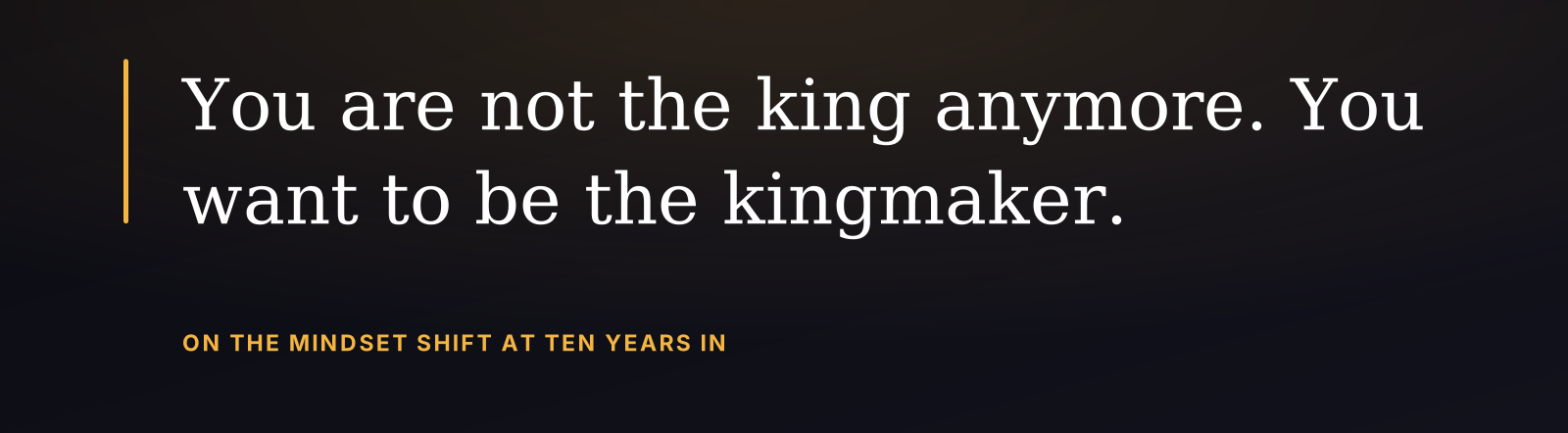
Third: seniority is a change of objective, not a promotion. His summary of the shift at ten years in is the line that stays with you: "You are not the king anymore. You want to be the kingmaker."
Underneath all three is a category problem that makes his job unusual and his answers more honest than most. In space tech, the customer often does not yet know the technology exists, so the work starts years before any deal — "you would not believe the amount of time we spend with customers without any sales agenda."
The story
Start with the jeans, because the entire philosophy is compressed into it.
"Say you go to a shopping mall, you don't have your wife with you, you go alone, and you want to buy a pair of jeans. So you pick up three or four different variants. Nine out of ten times the salesperson will say — wow, it fits beautifully on you, you look great. It'll take some guts for the sales guy to say that this jeans is probably not fitting you well."
"But that one guy who does that is actually not being only a sales guy. He is also being a well-wisher."
The reason this is not merely a nice sentiment is structural, and it is about how information now moves between buyers:
"The world has become very small. All your customers talk to each other. Enterprises speak to each other. Best practices are shared. You have a lot more conferences, industry interfaces. And therefore, if you try to mis-sell, if you try to treat sales as a one-off transactional activity, you're essentially killing yourself from winning evangelists."
He offers the evidence from his own career, and it is the kind that only accumulates over a decade: deals that did not close, where the prospect went on to introduce him to other prospective customers, invited him into meetings, and built a lasting relationship — "because I was just his well-wisher."
The second thread running through the episode is the shape of a career, and he is unusually specific about what each phase is for.
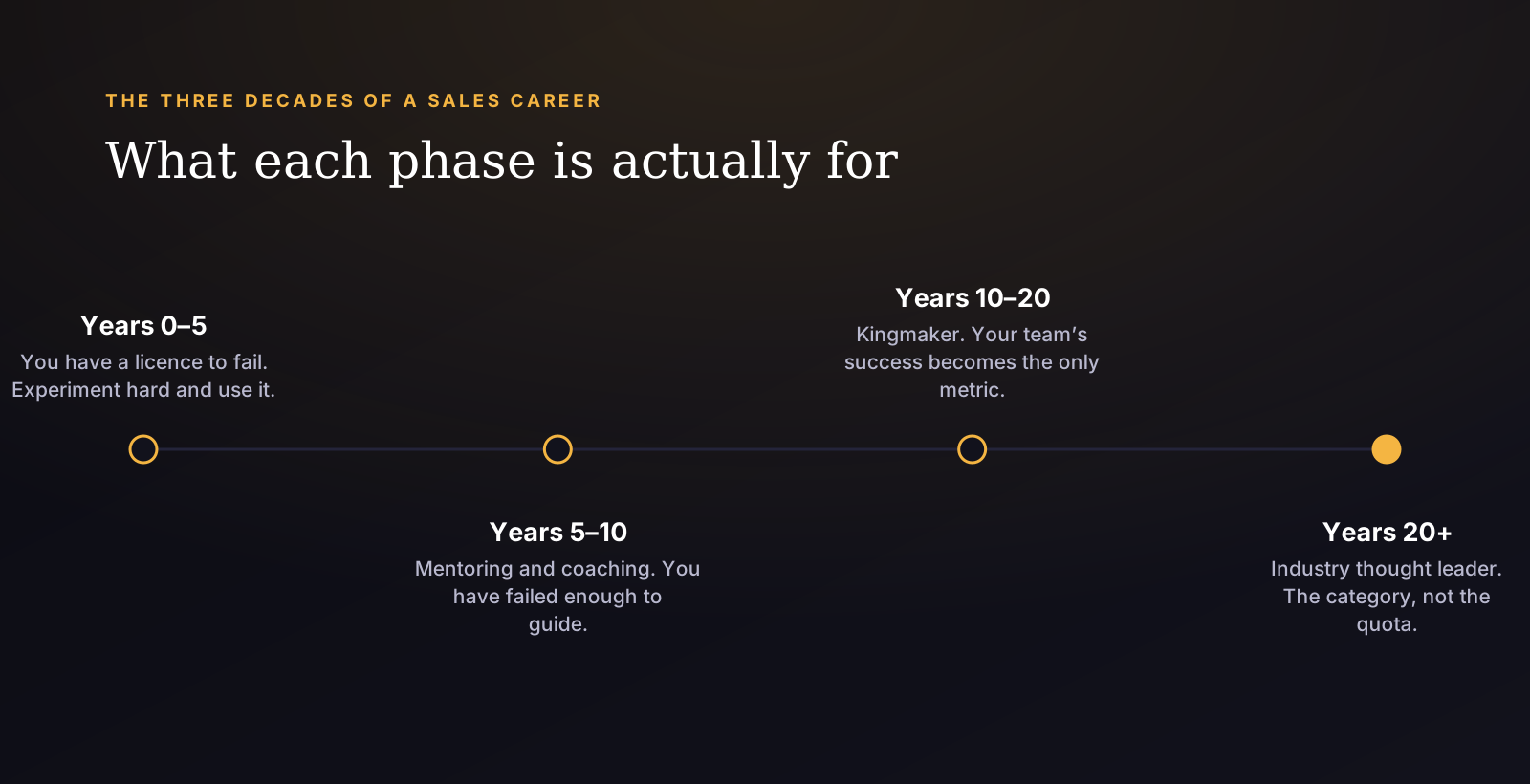
"In the first five years of your career, I think you're guaranteed and you have the licence to fail. So you can experiment a lot. You can try to do things on your own, innovate, bring out new strategies and tactics."
Then five to ten, when people start reporting to you and "you're not only responsible for driving your individual metrics but also your team metrics" — a phase that works only because "it is expected that between one and five years you would have failed enough to know what works and what doesn't."
And then the shift he is currently living through:
"Beyond ten to twelve years into your career starts a time when you become a leader. And the biggest mindset change required to get here is that you are not the king anymore. You want to be the kingmaker. You want your teams and your managers behind you to succeed — and when they succeed, you succeed."
"Because now the organisation is my goal."
The third thread is what makes his current job strange, and it is the most instructive part for anyone selling something genuinely new. Commercial space technology in India is a young category. Customers are not using it day to day. There is no established buying process to slot into.
So the work starts long before anything resembling a sale:
"You would not believe the amount of time we spend with customers without any sales agenda. We just spend days and weeks engaging with them, understanding their processes, before even proposing a solution that we may propose."
Then validation, back-testing, education. And then the part most companies cannot sustain:
"The trick is to do it relentlessly. The trick is to do it repeatedly, over a sustained period of time, up until the time you have some kind of uptick in the adoption curve."
He puts the timeline at roughly three to four years of sustained effort before they saw meaningful adoption — and frames it against Rogers' diffusion of innovation curve, which every emerging category has to climb.
Key decisions
Decision 1 — Start with why, not with what you have
He is a Simon Sinek reader, and he applies the golden circles to a sales conversation via an analogy that lands harder than the framework does:
"Simon Sinek says that having a sales conversation is like dating. Imagine you go and sit in front of a girl on a date and you say — hey, I'm very rich, I have a five-bedroom penthouse in upscale Bombay, I drive a Porsche, I have fifteen servants, I have so many million dollars in the bank. That's already a very bad date happening."
The correction is the same in both settings. Start with why you came — what the goal is, what the purpose is. Then how you serve that purpose. Then, last, what you actually do.
"The how and the why always have to be aligned with solving a problem — because unless you know what problem you're solving, you don't know why you exist."
Decision 2 — Solve the problem optimally, not impressively
A discipline that separates engineers-who-sell from sellers-who-last, stated as three steps:
- Understand the customer's problem — genuinely, from inside their process.
- Find an optimal solution. Not the most complete one. "You can think of solving a big problem in a big way, but it may not be commercially viable."
- Then look at scalability — whether the solution can be repeated widely enough to matter.
The middle step is the one people skip. A technically magnificent answer that nobody can afford is not a solution; it is a demonstration.
Decision 3 — Treat retention as the main event
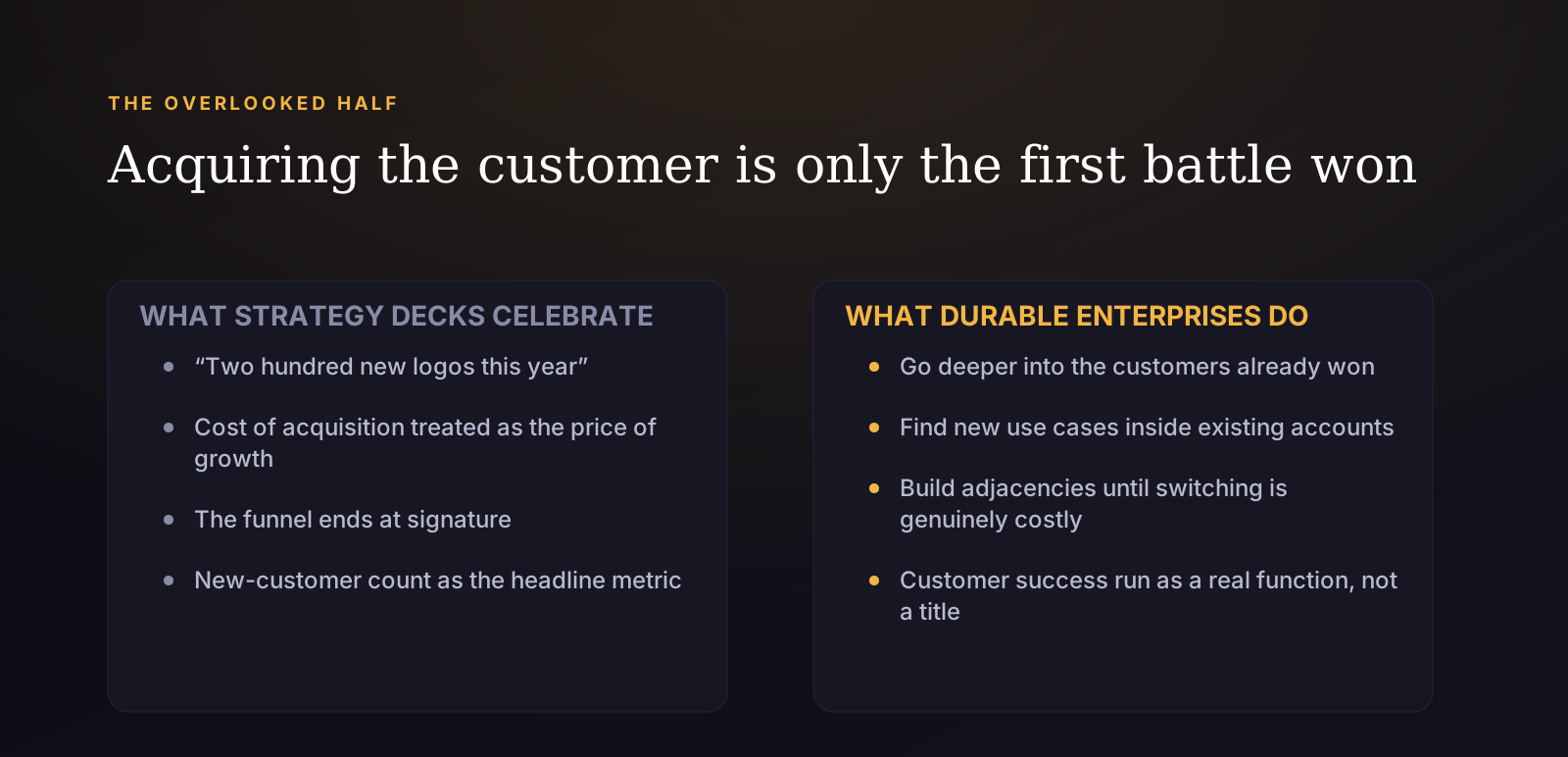
Asked which stage of the funnel matters most, he names the one that gets the least airtime:
"Today, the cost and effort of acquiring a customer is a lot higher than growing and going deeper into your own customer set — especially in enterprise businesses."
And he is direct about why this is unfashionable:
"Sadly it's a little downplayed. You go and talk to many organisations about strategy, and you'll hear companies talk about acquiring hundreds of customers in the next one or two years. But the real successful large-scale enterprise businesses are those who have been able to farm and retain their customers well over a period of time."
The mechanics of farming, in his words: stay very close, keep your ears open, build adjacencies to your product, go deeper in consulting, enhance the proposition, and hold NPS and CSAT high. And then create the thing that makes the relationship durable — hooks, and deep technical integration.
He is careful not to overcorrect: "I'm not saying acquisition isn't important. It's very important to keep your onboarding rate high." The claim is about proportion, not priority.
Decision 4 — Earn the cost of change
The natural objection is that customers have options, so relevance has to be bought again every renewal with new features and better pricing. He does not accept the framing:
"I don't think that is always the case in an enterprise environment. Once you are able to create a good relationship, you're helping and serving them well, you are deeply integrated with them, you try to innovate with them, there are times when you co-create with them. But more than that — the customer feels the pain, or there is a huge cost of change."
"If you are deeply embedded in a customer's day-to-day operations, there is a very deep and high cost of change that one has to go through."
This is worth reading precisely, because it is easy to mistake for lock-in through friction. What he is describing is earned depth — co-creation, integration, adjacent products the customer actually uses. The switching cost is a consequence of being useful in many places, not a trap laid in the contract.
Decision 5 — Move from high touch to low touch without losing the customer
On the tension between sustainability and profitability, his answer is unsentimental about where the industry is going:
"The revolution of people-led, high-engagement, high-touch models is being replaced with high-end CRM software, agentic engagements, and low-touch sales models. That's where you optimise your cost and increase efficiencies — while not compromising on customer experience, because that is of pivotal importance."
"Especially in enterprise class sales, things have dramatically moved from high touch to medium touch to now low touch."
Where humans remain: "I see human intervention only in high-end, complex, consultative sales environments — whereas largely your adoption-driven journeys will be product-led and agentic."
That is a specific and testable prediction about which half of a sales organisation survives contact with the next few years.
Mental models
Integrity, reliability, intimacy
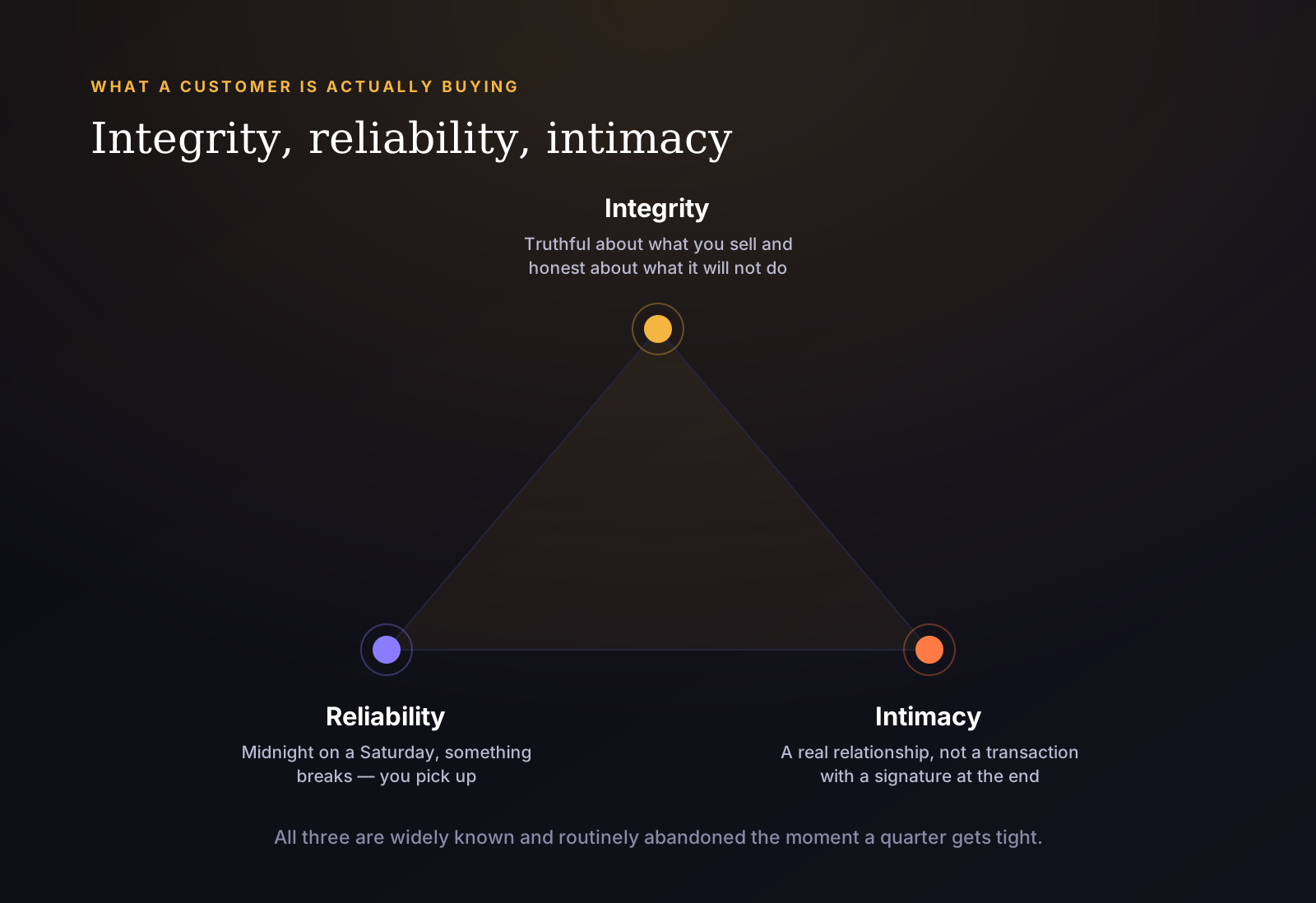
His three-part model of what a customer is actually buying — and his aside about it is the interesting part:
"While all of this is known to people, you'll be amazed at how people get carried away not doing it in a real environment."
Integrity — "integrity in what you're selling, how truthful you are to the customer, how transparent you are, how you're setting your expectations."
Reliability — defined by a specific, unglamorous test: "even if it is twelve at midnight on a Saturday, if something is going wrong, they should be able to pick up the phone and dial — and somebody answers. That's a sign of being reliable."
Intimacy — which he concedes is "a little bit gifted": where are you from, what are your interests, do you play golf on Saturdays, can I join you for lunch. A real relationship rather than a transaction with a signature at the end.
None of the three is a technique. Each is a cost you either pay or don't, and the customer can tell which.
Two ways to win a war
His framing for why partnerships have become structural rather than opportunistic:
"There are two ways of winning a war. Either you build your own army, or you partner with somebody who has a larger army."
He reaches for colonial India as the illustration — the British arrived without anything close to a comparable force and won by partnering with those who had larger armies.
The modern version is a consequence of software economics:
"With SaaS there is no physical movement of goods. Sitting in India, you can sell a licence to somebody in the US or UK or Canada. That has enabled you to have a much broader span of control over the world. But at the same time, you cannot have engagement people across the board. You cannot have an army across the globe."
So partnerships and channels become "two very critical mediums at which you can optimise your span of control."
His example of a genuinely mutual arrangement is the cloud marketplace: the provider lists you, their teams take you to their customers, you replicate your solution in client environments — "and for them the win-win is that their cloud bill increases." Both sides profit from the same event, which is the only durable definition of synergy.
Partnership is a marriage
The warning attached to all of the above:
"Partnership is essentially like getting married. You just can't pull off as you wish. There has to be a lot of due diligence before you get into partnerships."
The reason is customer experience. A distribution partner with real presence in a market can still be the wrong partner: "somebody may be in Australia with a great amount of prowess and presence, but they may just not be the right person to distribute — because of their mindset." And the customer will not distinguish between you and them.
Strategy is option selection
He gives the textbook definition — leveraging your strengths and competencies to gain competitive advantage — and then his own, which is more usable:
"Strategy is basically your ability to check the options, evaluate the options, and select the right option or door for you to take the right call. And that right call should lead to competitive advantage."
Two observations sharpen it.
The first is a boundary condition most strategy writing omits: "If you're a monopoly business, you really would not need strategy. You need strategy when you're in a competitive environment."
The second is the distinction that gets collapsed constantly:
"Often strategy is misunderstood as tactic. Tactic is very short-term. Strategy is a longer-term vision — multiple quarters, sometimes a few years. If tactic is a battle, then strategy is a war."
And the options you select from are not arbitrary: you choose "the options which best align to your organisation's resources and capabilities." Strategy is downstream of what you actually have.
Education before adoption
For anyone selling into a category that does not yet exist in the buyer's mind, his account is the most practical description of the work.
"Particularly in space tech, it's a new domain. Customers and industries are not necessarily using such technology in their day-to-day. So it's very important for one to be patient."
The work: explain the back end, explain the technology powering what they see in the front end, spend days and weeks understanding their processes, validate, back-test, educate. Then repeat it relentlessly until the adoption curve moves.
"We have our ears on the ground. We go beyond our way to actually listen to their pain points."
He also frames it as a privilege rather than a burden, which is the right posture for a category creator: being early means "it is therefore our privilege to set this up as a category and create a niche."
Frameworks
Framework 1 — The three types of partner
Each with its own selection criteria. Confusing them is how partnerships fail.
| Type | What it does | What to select for |
|---|---|---|
| Technology | Co-create products, transfer technology, build IP together | A genuinely complementary offering, and a common audience already waiting for the combination |
| Go-to-market / distribution | Extends reach into markets where you have none | Shared values and a similar philosophy on acquiring, servicing and growing customers |
| Strategic / evangelist bodies | Institutional association that shapes a whole market | Structural influence over how the category behaves |
The third type is the least obvious and often the most powerful. At Tally, the association was with the chartered accountant community — "because the chartered accountant community influences accounting" — which he describes as "a beautiful symbiotic relationship." At SatSure, the equivalent is presence on the RBI innovation hub's Unified Lending Interface platform.
His technology example is deliberately mundane and therefore useful: CRM players integrating with lead-generation players. Complementary, obvious once built, and with an audience that was already waiting.
Framework 2 — The well-wisher test
One question to run before any customer conversation.
If the honest answer were "this isn't right for you," would I say it?
| Answer | What you are | What you build |
|---|---|---|
| Yes, and I have | Well-wisher | Evangelists who refer you even when they don't buy |
| Yes, in principle | Not yet tested | Unknown — the quarter will decide |
| No, not this quarter | Transactional seller | Customers, until the first better option appears |
The economics behind it are the small-world argument: buyers talk, conferences exist, best practices circulate. A mis-sell no longer costs you one account — it costs you the referrals that account would have made.
Framework 3 — What to measure after the sale
Acquisition metrics are well developed. These are the ones that decide renewal.
Before the sale, back-test data to show correlation and uptake — "that helps customers take quicker decisions to purchase and adopt."
After it, track at regular intervals:
- Efficiency gains inside the customer's organisation
- Cost impact
- Additional business generated
- Procurement cycle improvements
"All of that is pivotal to your strategy of retention and growth, and going deeper into that customer."
His observation about why this now matters more than it used to: five years ago ROI was evaluated periodically before renewal. Today, because the customer's own journeys have become digital, "they are able to understand the value of your solution much better" — which means the value has to be real and visible continuously, not assembled into a slide at renewal time.
Framework 4 — Strategy for an individual salesperson
Asked what strategy a salesperson should hold, his answer is deliberately anticlimactic:
- Be a well-wisher.
- Be good to your customers.
- Understand and solve their problems.
- Build relationships — "no matter what you say, in India or abroad, sales and business roles are relationship driven."
- Increase your circle and your span of control.
- Be focused in your job.
"And that's about it. I mean, that's not complicated. Not at all."
The episode lands on a line worth keeping: rather than complicating things, being straightforward is the strategy.
Lessons
Selling
- Be a well-wisher first. The salesperson who says the jeans don't fit is the one building something durable.
- Buyers talk to each other constantly — a mis-sell costs you referrals, not just a deal.
- Start with why, then how, then what. Leading with what you have is a bad first date.
- Solve the problem optimally, not impressively. Commercial viability is part of the solution.
- Acquisition is the first battle won, not the war.
- Going deeper into existing customers costs less than winning new ones, especially in enterprise.
- Build hooks and deep integration so that switching becomes genuinely costly — by being useful, not by trapping.
- Integrity, reliability and intimacy are widely known and routinely abandoned under quota pressure.
- Reliability has a concrete test: midnight on a Saturday, does someone pick up?
- In emerging categories, expect years of education with no sales agenda before adoption moves.
Strategy and partnerships
- Strategy is evaluating options and choosing the one your resources actually support.
- A monopoly needs no strategy. Competition is what makes it necessary.
- Tactic is a battle; strategy is a war. Do not confuse the timescales.
- You cannot staff an army across the globe — partnerships are how span of control scales.
- Match the selection criteria to the partner type; complementary tech, shared values, structural influence.
- Partnership is marriage. Do the due diligence, because your customer will not distinguish you from your partner.
- The only durable partnerships are ones where both sides profit from the same event.
Career and leadership
- Years 0–5 are a licence to fail. Spend it experimenting, not protecting your record.
- Years 5–10 are for mentoring, made possible by having failed enough to know what works.
- At ten years in, stop being the king and start being the kingmaker.
- Generations with genuinely different priorities now sit in one team — be open to change rather than expecting them to adopt yours.
- Embrace AI rather than resisting it; the anxiety is real, and the resistance is still futile.
Actionable advice
This week
- Run the well-wisher test on your live pipeline. Which deal would you walk away from if you were honest about fit? What would it cost you to say so?
- Rewrite your next customer opener to start with why you came, not what you sell.
This month
- Compare what you spend acquiring a customer with what you spend going deeper into existing ones. If the ratio surprises you, that is the finding.
- Pick your three largest accounts and list the adjacent problems you have never asked them about.
- Audit one partnership against the right criteria for its type. If it is a distribution partner, are their values and service philosophy actually close to yours?
This quarter
- Define your post-sale metrics — efficiency, cost, additional business, procurement cycles — and start tracking them at a fixed interval rather than at renewal.
- If you are early in a category, budget for education with no sales agenda and commit to it for years, not quarters.
- If you are past ten years, name one thing you are still doing as the king that should now belong to someone on your team.
Final thoughts
The two ends of this conversation seem unrelated and are not.
At one end is a man in a shop deciding whether to tell a stranger the jeans don't fit. At the other is a company spending days and weeks inside a customer's operations with no sales agenda, in a category so new the customer does not yet know it exists, sustaining that for three or four years before the adoption curve moves.
Both are the same trade: give up something now that is easy to take, in exchange for something later that cannot be taken at all. The commission on the jeans is available immediately. The evangelist who introduces you to three other buyers is not, and only exists because you passed on the commission.
That trade is also the whole content of the kingmaker shift. For ten years your own numbers are the point, and then they stop being the point, and the thing you are building is other people's success. It is the same subtraction one level up.
What makes his version credible is that he does not pretend the trade is free or comfortable. It takes guts to tell the customer the fit is wrong. It costs real money to spend weeks with a prospect who may never buy. And handing your team the win, after a decade of learning to take it, is not a natural motion for anyone who got good at sales by being personally excellent.
"You want your teams and your managers behind you to succeed — and when they succeed, you succeed."
Kumar leads business at SatSure, an Indian space-technology company. He has previously held sales and go-to-market roles at HCL, Tally and Pine Labs.